Wednesday, January 26, 2011

"Literary Tune-Ups" Just in Time for GoG Release

Given my cousin's fantastic EP release this week--Ghost of Gloria, Trial + Virtue--I thought it was very apropos of Boldtype/Flavorwire to send along a list of musicians turned authors today.

And we're not dealing with celebrity music memoirs here; we're talking straight-up literary endeavors--poetry and short story collections, and novels.
Animated celebrity and noted philosopher Homer Simpson once mused, “Rock stars. Is there anything they don’t know?” Although many musicians parlay their stage success onto the printed page with memoirs, few make the foray into fiction. Last week, news broke that Bob Dylan signed a six-book deal, set to include two follow up volumes to his 2004 autobiography Chronicles as well as three other books of undetermined content. Dylan crossed over early in his career with the experimental novel/stream-of-consciousness liner notes/poem Tarantula in 1966, placing him among a small group of musical chameleons who — like their academia-inclined and thespian colleagues — have jumped artistic genres. While we wait to see if Tarantula 2 is among Dylan’s new literary offerings, here’s a list of stand-out works of fiction by other rock stars.

Wildwood by Colin Meloy - As the ship’s captain at the helm of the Decemberists, Colin Meloy is best known for writing songs about whales and other esoterica. But for his first literary foray, he’ll publish a series of books aimed at a young adult audience. Wildwood, which will debut in the fall, is a collaboration between Meloy and his illustrator wife, Carson Ellis, whose art adorns the covers of several Decemberists records. Last year, Meloy told NPR the books were “a classic tale of adventure, magic, and danger, set in an alternate version of modern-day Portland, Oregon.” Isn’t that what Fred Armisen and Carrie Brownstein are up to on the IFC Channel?

Doghouse Roses by Steve Earle - Long celebrated for his songwriting, cult country rebel Steve Earle put down his guitar in 2001 and picked up a pen to try his hand at short-story writing. The result is Doghouse Roses, a collection of tales that sounded, well, a lot like his songs. The stories take us to many of the places Earle has traveled — lonely hotel rooms, smoky bars — and introduce us to characters, who, like the author, have made bad choices or been unlucky in love. Here we meet drug addicts, Vietnam vets, and hitchhikers. A decade on, Earle’s still best known for his music (and perhaps his guest stints on The Wire), but the tales of Doghouse Roses remain a testament to his immense talent as a storyteller, whether in song or on the page.

Auguries of Innocence by Patti Smith - The Godmother of punk stunned the literary world in 2010 when her loving chronicle of her long friendship with artist Robert Mapplethorpe, Just Kids, won the National Book Award. The disjointed and dreamy narrative of passion, ambition, and eventual success was poetic and musical, and celebrated, above all else, her love of language and literature. Patti Smith has been writing poetry for decades, and this collection, which was published in 2005, wears the influence of William Blake in its title (and owes a little to Rimbaud, too). Beloved and barrier-breaking, Smith has found success in literature, music, visual art, and performance, but this collection shows why she’s so enduring.

Hard Ground by Tom Waits - Tom Waits once claimed: “I don’t like the stigma that comes with being called a poet.” But this spring, that’s exactly what he’ll be called, when Hard Ground, a collaboration with photojournalist Michael O’Brien, debuts in March. A searing portrayal of homelessness, the book combines portraits and poems to chronicle the lives of outsiders and castoffs — themes that Waits has revisited throughout his four decade songwriting career. By asking us to look at those from whom we’d rather turn away, Waits makes the invisible visible and, like his music, deepens our understanding of what it means to be human.

See the unabridged list and original post HERE

I have to admit, a bunch of these surprised me, particularly the news of Patti Smith winning a National Book Award. It's one of those things I should have known but had no clue about. Perhaps I'll have to tack Auguries of Innocence onto my to-read list...

Tuesday, January 25, 2011

Guest Blogger, Dan Cabrera: "The Office" Walks Into A Bookstore

You booklovers out there who saw last week’s episode of The Office, “Ultimatum,” may have perked up a bit when three characters walked into a bookstore. For a show ostensibly about people working in an industry that is rapidly diminishing or changing (paper sales), a bookstore should be a familiar setting to the characters, and one that could be a goldmine for jokes. It’s too bad the segment failed to deliver.

In the episode, Darryl (Craig Robinson), Dwight (Rainn Wilson), and Andy (Ed Helms) decide to fulfill their New Year’s Resolutions. For Dwight and Andy, that resolution is to “Meet a Loose Woman,” but Darryl’s goal is to simply read more books. Darryl, always the smooth operator, convinces Dwight and Andy that a bookstore is the perfect place to meet easy girls. All you do is ask a “cutie” what she’s reading then ask if they want to hang out—which, according to Darryl, leads to something more than just late-night discussions on who’s your favorite Brontë sister. It’s that simple. (If it’s actually that simple is the topic for another post.)

When the trio arrives at the bookstore they split up, each deciding to take a section to scour for babes. While Andy and Dwight stake their territory, Darryl goes straight to the saleswoman who is selling eBook readers. This is a generic chain bookstore apparently named Owl, which resembles a typical Borders or Barnes & Noble. A quick glimpse at some of the titles in the background doesn’t give away much. In fact, it looks as if some are prop books, though if you look closely you can see a copy of Jonathan Franzen’s Freedom in the background.

The real fun of the scene happens when Darryl is sold an eReader. The only eReader that seems to be on sale is Kobo’s wireless eReader. It’s a bit hard to tell if Kobo paid for the inclusion of their eReader, or if the producers happened to film in a Borders (or, they didn’t want to offend B&N or Amazon). When offered the eReader Darryl hesitates, claiming he is scared to death of the machines. Because he works at a paper company, he argues, these little contraptions can put him out of business. The saleswoman is persistent, and corrects Darryl when he says he heard the device can carry “ten books at once,” when it’s more like ten thousand. Add the fact that the device is so light (“Like a croissant!”) and Darryl is sold.

Dwight and Andy can’t seem to pick up any ladies at the bookstore and when they leave with Darryl they ask to check out his purchase. Darryl, embarrassed, comes up with a clever lie to keep the other two from looking in his bag (I won’t give it away).

And that’s the end of the bookstore. Yes, later we see Darryl enjoying the eReader, still trying to hide its existence from his friends, but The Office has seemed to close the book—if you’ll pardon the pun—on the idea of eReaders. It’s entirely possible Darryl’s eReader will come back to haunt him, but it’s doubtful.

As publishing insiders know, eReaders are turning the book market upside down. Ebook sales are beginning to surpass physical book sales, a frightening prospect for many in the publishing world. Brick-and-mortar chains aren’t faring well, and it would be foolish not to point to eBooks as part of the problem. Paper books are becoming redundant, to borrow some office lingo.

This is ripe territory for The Office. They’ve dealt with publishing at least once before, when the Dunder Mifflin Scranton branch was able to capture a major New York publishing company as a client. For most of the series’ run, the plots focused on the floundering paper company in an increasingly paperless world. The threats of layoffs are a recurring plot device, and this scary prospect is ringing all too true for publishing employees. The idea of a paper salesman abandoning paper books is sacrilegious! It’s traitorous! It can also lend itself to some great comedy. So it is surprising the idea was treated so casually on last week’s episode.

What if, instead, Jim Halpert (John Krasinski) was using an eReader in the office? Obviously this is heresy, and a good portion of the episode could revolve around Jim trying to hide his eReader from Michael. Eventually, Michael would find out, become upset, do something zany and frustratingly embarrassing. But in the end he would realize—as he so often does—that he has to adapt to the world, rather than trying to make the world adapt to him. It would be slightly more interesting, slightly more relevant, and maybe produce some bigger laughs.

Maybe I’m being too hard on The Office. After all, the show isn’t really about paper. (And don’t they sell printers now? Do they even sell paper anymore? And whatever happened to traveling salesman Timothy Olyphant?) The show is about relationships, about average folks trying to get by in this difficult world. The Office is about the awkward, embarrassing, and downright sad trials of everyday life. But it shows us that with a few laughs and some good friends, we can get by and come out on top.

Hopefully the show will revisit books and eReaders. I think there is more to be said there, and who better (and funnier) to say it than The Office?

A BRUSH OF DARKNESS Officially Hits Shelves


YAYYYYYYY!!!!!!

*dances around in her towel*

Happy on-sale day, Allison Pang!!!!!!!!!!


Monday, January 24, 2011

The countdown begins...

Just more three hours until Allison Pang's debut urban fantasy novel, A Brush of Darkness, hits shelves!

Please head out and buy a copy or order the e-book for your e-reader...it'll rock your world!

It certainly changed mine...
(I know. I'm shameless. But this book is worth it!)

Thursday, January 20, 2011

B&N Lays Off 40+ Book Buyers and More

It's no surprise that in this extremely volatile market, major publishing and bookselling corporations have been struggling. Indies closing, Borders unable to pay its bills, houses reorganizing imprints and laying off employees, etc. The one book biz staple we hadn't heard much from was Barnes and Noble.

Until yesterday, that is, when the news that Barnes & Noble was "restructuring" their office environment by laying off more than 100 staffers spread like wildfire yesterday.

Readers and industry insiders alike are up-in-arms about this new development, not only because of the firings themselves but also because of B&N's cavalier attitude toward the matter.

Here's the skinny from Publishers Weekly:
Barnes & Noble has confirmed what it is calling “a small number of organizational changes this week” that the retailer said were “designed to better align our resources with our business.” The changes appear to be mostly in the buying group. B&N wouldn’t confirm the number or names of people let go, but PW has learned that Bob Wietrak, the well-known v-p of merchandising, and Marcella Smith, director of small press and vendor relations, have left the along with a number of buyers, including cookbook buyer Lee Stern. Reports say about 45 to 50 positions in the buying group were eliminated.

A B&N spokesperson stressed that the company is reallocating resources to areas that are expanding, such as its digital operations, but had no comment on how duties of the departed buyers and others would be divided up. Publishers were shook by the news with the larger publishers wondering who would oversee merchandising, while smaller presses questioned who would be looking out for their interests. The growth in digital is great, one publisher noted, but added "someone has to be in charge of getting books into the stores."

See the article HERE
The news certainly hit home for a lot of people I know, with many of them closely acquainted with some of the laid-off employees. While I don't have any personal relationships with the buyers and other staffers that were let go, it's a sad state of affairs in publishing these days. It's upsetting not only on an individual level but for the future of the industry as a whole...

Tuesday, January 18, 2011

S&S Builds Buzz Without an Author

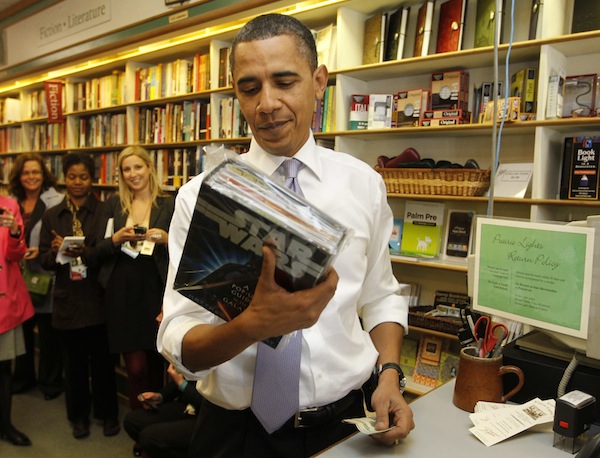
With 2011 came a mysterious acquisition announcement from Simon & Schuster: O: A Presidential Novel.

Some speculate, of course, is that Obama himself is trying his hand at fiction, despite S&S denying such claims, while others question well-known authors and journalists. But no one can know for sure until the book hits shelves next week.

S&S is keeping things under wraps as best they can, going so far as to askingreporters not to comment on the story until it's been released. Yahoo! News writer Michael Calderone tells us more:

Time's Joe Klein said he didn't write Simon & Schuster's forthcoming Obama novel. Several other Beltway figures, in media and politics, have also denied being the anonymous author behind "O: A Presidential Novel," which hits bookstores next week.

Given such denials, could the field of likely suspects be narrowing down too much? Simon & Schuster seems to think so.

NBC White House correspondent Chuck Todd tweeted Tuesday that he received an email from the publisher that included the following request: "You may be asked to comment on whether or not you are the author. If so, it would be great if you refrained from commenting."

Todd's not alone. Klein -- who wrote the political novel "Primary Colors" anonymously -- told The Cutline that Simon & Schuster contacted him, too.

It's not clear what prompted the publisher to ask journalists not to comment on a book they have nothing to do with. (A Simon & Schuster representative didn't immediately respond to questions on the matter.)

Simon & Schuster publisher Jonathan Karp, in the email, requested that journalists not comment "in solidarity with the principle that a book should be judged on its content and not on the perceived ideology of its author." Read Karp's full email below:

On January 25, we'll be publishing a secret novel simply titled O, about President Obama's campaign for re-election in 2012. The author of the novel wishes to remain anonymous. You may be asked to comment on whether or not you are the author. If so, it would be great if you refrained from commenting, in solidarity with the principle that a book should be judged on its content and not on the perceived ideology of its author.

The author, an individual with integrity and talent, is someone who has been in the room with Barack Obama and knows the political world intimately. In fact, you may know this person, or know of this person -- if you are not in fact the author yourself.

Thanks in advance for your consideration. I apologize for the impersonality of this blind group email, but this seems like the best way to protect the author's identity. I hope you enjoy the book. It's terrific.

For a sneak preview of O and a special video address from the President of the United States, go to www.othebook.com

Best regards,

Jonathan Karp

Publisher, Simon & Schuster

(Photo of President Obama in an Iowa bookstore last year: AP/Charles Dharapak)


See the original article HERE

Protecting such anonymity is an interesting publicity tactic for S&S. It's also seemingly successful--just check out the book page the publisher has created for the title. Curiosity is certainly on the rise.

It's common for publishers to hold back announcing acquisitions until just before a book goes on sale, but I can't think of another example of one quite this secretive. And I'm not sure it's the best approach. While it has, of course, gotten people discussing the upcoming release, the book still has no real tangibility or credibility sans author. Word of mouth doesn't spread nearly as quickly and effectively with such a huge chunk of information missing. Besides, this kind of hype makes it feel just like that--hype.

I guess I'm just a more classic publicity fan. Tell me what the book's about, who wrote it, and why it's special and perhaps I'll jump on the bandwagon. Keep me in the dark and watch my interest decrease...or disappear altogether.

Thursday, January 13, 2011

Guest Blogger, Meghan Stevenson: Gloves Off in the E-reading Arena

I live in the book world. My friends are editors, agents, publicists, marketers. We all speak the same language, full of pub dates and signatures and e-books.

But I do have friends on the outside. And the other night, I was privy to a very interesting conversation. I was out with five friends of varying professions, and the talk turned to e-readers. I had my Kindle; my friend Josh—who works at a hospital—had his Nook.

As an aside, I must admit I adore my Kindle. If I leave without it, I feel wrong, just like I did when I first got an iPod or a cell phone. I mean, what am I supposed to do, read an actual book? But at dinner Josh’s Nook initially wiped the floor. He showed off the color touch screen and some of the animation his kids’ books had. Everyone appropriately oohed and ahhed. But then I showed people the cartoons from The New Yorker which were crisper. And the text was better.

“How much is it?” Maddie asked Josh.

“$250?” Josh said about his Nook.

“About $150 when you factor in the cover,” I said, hoping that Maddie would choose me. She asked to play with my Kindle, so I handed it over, showing her how to turn the pages and find individual chapters.

“And how much are books?” she asked. I briefly explained the agency model and how publishers are working with Amazon and B&N to sell e-books at reasonable prices. Then the most interesting segment of the conversation came in.

“I don’t want to pay for books,” interrupted our friend Yama. “I just want to read. Can’t I borrow them from the library?”

“I think they’re still working that out,” I explained and she made a face. “But whatever one store or product does, everyone else ends up copying it eventually. So, for instance, a few months ago someone who had the Nook could lend to other people who had the Nook. But you couldn’t do that on the Kindle—though now, you can.” This got nods all around. “So I expect that library lending will come about eventually. But Yama,” I said, “you know that buying books pays the author and me, right?”

This is an interesting point that few people realize. In fact, my best friend (who also works outside publishing) called the other day to crow about finding all of Stephen King’s e-books for free online---clearly stolen or illegally copied. I hung up on him. When he called back, I told him: “My salary just disappeared.”

Here’s the crux: people want content for free. Whether it’s a Britney Spears single, an e-book or a New York Times article, if we can get away with not paying for it, we will. (And I’m certainly no exception.) That’s because largely, our society thinks of piracy like this: Stephen King, hugely bestselling author, rich guy. He doesn’t need my $9.99. The New York Times, they sell subscriptions, they’ll still exist even if I, an individual, read it solely online for free. Britney Spears, she has tons of mansions and concert revenue, she doesn’t need or even get the .99 cents from iTunes, so why should I pay it?

But all artists need people to pay for their content. While Stephen King may or may not need the advance and royalties off his backlist, Scribner certainly does. It has to pay the editor , her assistant, the cover designer, the production editor, the copyeditor, the publicist, and everything else related to the publication of that book that the consumer never sees and often doesn’t even know exists. And that’s where the conflict comes in.

We’re at a precipice in publishing, where the normal consumer like Josh, Yama, and Maddie are buying Kindles and Nooks. If we want to compare the book publishing industry to music, as we do often, I think we’re in 2004 or 2005. That’s the moment where the early adopters and dedicated music lovers met the average consumer, and iPod sales went through the roof. Hopefully, just like music, book publishing will witness a moment where people give up on finding the new Napster or LimeWire and decide just to buy the new single on iTunes because it’s easier. There’s a moment where it becomes easier to pay than to pirate—and that, I believe--among other factors--will keep publishing afloat.

And, as a side note, all the devout readers in my group of “outsider” friends—including the reluctant Yama—preferred my Kindle.