Showing posts with label studies. Show all posts

Thursday, May 7, 2015

Scholars Discover 150 Unpublished Stories by Mark Twain

Just when you thought classic American Literature couldn't get any better with the upcoming second novel from Harper Lee, scholars at the University of California, Berkley proved that thought wrong. Just this week the news broke that they discovered over 150 unpublished stories by Mark Twain.

The Guardian tells us more:

Scholars at the University of California, Berkeley have uncovered and authenticated a cache of stories written by Mark Twain when he was a 29-year-old newspaperman in San Francisco. Many of the stories are 150 years old. 
Twain wrote some of the letters and stories at the San Francisco Chronicle when it was called the San Francisco Dramatic Chronicle, where his job included writing a 2,000-word dispatch every day and sending it off by stagecoach for publication in the Territorial Enterprise newspaper in Virginia City, Nevada. 
His topics range from San Francisco police – who at one point attempted, unsuccessfully, to sue Twain for comparing their chief to a dog chasing its tail to impress its mistress – to mining accidents. 
Bob Hirst is editor of the UC Berkeley’s Mark Twain project, which unearthed the articles by combing through western newspaper archives and scrapbooks. The author’s characteristic style authenticated some of the unsigned letters. 
Hirst told the Guardian the digitisation of newspaper archives had been like “opening up a big box of candy”, allowing as it did Twain’s articles to be tracked down in a way that was not possible when archives were all on microfilm. 
The articles were written, Hirst said, at a time of great uncertainty in Twain’s life, when he was trying to decide in which direction to take his career. 
“It’s really a crisis time for him,” Hirst said. “He’s going to be 30 on 30 November 1865, and for someone not to have chosen a career by that time in this period was quite unusual.” 
Twain had been resisting becoming a humorist, according to Hirst, because at the time humor was considered a lower order of writing. He was in debt and drinking heavily, and even wrote to his brother that he was contemplating suicide, saying: “If I do not get out of debt in three months – pistols or poison for one – exit me.” 
Nonetheless, the articles, Hirst says, are brilliant examples of Twain’s inimitable style. 
“He knows the city, he’s a bohemian of a certain kind, he’s interested in what’s going on,” Hirst said. “He simply weaves that all together with the greatest clarity and the greatest humour that you could possibly imagine.” 
See the original article HERE

I don't know about you, but I'm itching to get a look at these stories. Here's hoping his estate allows for posthumous publication!


Thursday, July 24, 2014

eBook Subscription Services On the Rise?

With more and more companies jumping on the eBook-subscription-service bandwagon, it's hard to believe that the service hasn't actually taken off yet. It's a fact that doesn't necessarily surprise me, but it does make me kind of happy, I'm not gonna lie.

While these services can benefit some authors greatly, which I am all for, the majority are more likely to be hurt by these "unlimited read" programs, and it's hard for me to get behind something like that doing what I do. At least until it's not a detriment to so many writers. While many could say that this Netflix-and-Hulu-watching girl is being a total hypocrite, the advances in subscription services for the book market just aren't up to snuff yet. 

But the big question is, When will it be? When is this all going to change? At what point will eBook subscription services become the norm? A recent study by the BISG tackles just those wonderings, according to Digital Book World:
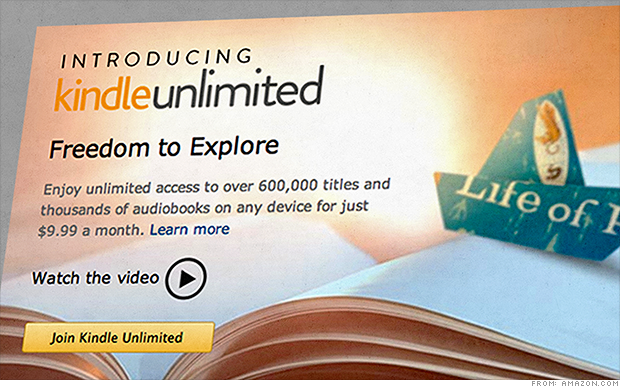
A report released today by the Book Industry Study Group (BISG) finds that 80% of publishers believe subscription ebooks becoming a major part of the publishing business is “inevitable.” The launch last week of Amazon’s subscription service, Kindle Unlimited, would appear to corroborate that finding — but are they? 
Professionals within the trade, scholarly, professional and higher education sectors interviewed for the BISG report had differing views on the various subscription-based models most likely to take hold in their respective categories. Among all those interviewed, however, there is a widespread belief that subscriptions are already playing expanding roles in each of those sectors, and that that trend will continue dramatically upward. Among trade publishers, only 7% of respondents said subscription services contribute significantly to their overall revenue today, but 59% expected that to change within the next five years. This is a case where the majority could be mistaken. 
Why? Because the most crucial questions for how — and how dramatically — ebook subscription services will reshape the industry are ones that no report can answer: Just how many authors and publishers will jump on? How deep will their participation be? And, ultimately, will readers buy? 
“One major concern surrounding the increase of ebook subscriptions,” the BISG report concedes, “is the potential degradation of high-value markets.” Yet the report indicates a prevailing belief among the various stakeholders in the publishing ecosystem that the benefits more often outweigh the costs: “New revenue from the emerging markets reached by subscription ebook options promises to offer some relief to publishers as they struggle with diminishing print sales.” 
But while price degradation, on the one hand, and upticking revenues from new subscription models, on the other, are possibilities, neither should be considered “inevitable.” 
It’s instructive to look for patterns in other forms of media where subscription services have taken hold, as the BISG report does, but publishing folks are often quick — and right — to point out that books are unique because, among other reasons, they’re consumed in a fundamentally different way than music, TV and movies. According the Bureau of Labor Statistics, the amount of time Americans spend watching television and movies far dwarfs the amount of time they spend reading. It makes sense to have a service that lets you choose what you want to watch and watch as much of it as you want. The same doesn’t necessarily go for reading. 
Besides, book publishers and authors have largely succeeded at continuing to get readers to pay for each time they consume content, even as the business models for newspapers, magazines and music have been upended and TV and movies continue to suffer from widespread piracy. As some of the latest figures from the U.S. and UK markets suggest, revenues from both print and ebooks are more than just holding steady; they’re increasing. 
This growth is being seen in a market dramatically shaped by Amazon’s deep discounting and the transition to cheaper ebooks from more expensive print books. If readers were fleeing in droves from existing retail channels or being converted en masse to the notion that paying anything more than a couple of dollars for a book (or anything at all, for that matter) is highway robbery, then authors and publishers would have far greater incentive to pursue subscription ebooks aggressively. 
But to all appearances, they don’t really have that incentive — at least not yet. Readers are still showing a willingness to spend on individual books. 
Furthermore, in order for publishers, authors and the service providers themselves to each cash out favorably, subscription models must perform a difficult balancing act that relies heavily on user behavior. On the one hand, they need to encourage many people to sign up; on the other, they need to make sure they stay signed up and reading, but not reading so much as to cost the services more than they make from having them as subscribers. One analyst writes that even Kindle Unlimited may be doomed right out of the gates as a consequence of that challenge. 
Publishers and authors, having watched ebook subscription services like Oyster and Scribd gain footholds in the reading market, are now familiar with that difficulty. On balance, publishers have shown considerable caution adding their titles to those catalogs. And authors have already stepped forward to criticize the way Kindle Unlimited proposes to compensate some of them. 
In light of all this, the scope and nature of ebook subscription services’ impending impact on the industry looks if not more limited, then at least less “inevitable” than respondents to the BISG study anticipate. In a live debate Digital Book World hosted in June, in which executives from Scribd and Smashwords faced off with a business journalist and the head of a global ebook distributor on this very question, the skeptics carried the day, convincing a greater share of the audience that the potential costs to publishers, authors and readers outweighed the potential benefits. Even though the majority of attendees continued to feel optimistically about the place of ebook subscription services in the world of publishing — as do the publishers BISG surveyed — the fact that such caution remains in ample supply suggests that an industry-wide embrace of subscription ebooks is still far from certain. 
While it may not have impacted the results, it’s important to mention that the BISG survey was sponsored by ebook subscription providers Safari and Scribd, among others. Learn more about the report and purchase it here. 
See the original post HERE

Interesting stuff. Terrifying stuff. But interesting...

Wednesday, June 25, 2014

Teen Reading Statistic Ridiculousness

This morning I was wishing (again) that I could just curl up with a good book and read all day, just for fun. I remember doing that so often in the summer when I was a kid. I had one of those miniature Jennifer Convertibles in my room, and I'd sit there all day long, squished up between the arms, a stack of novels next to me, and just read and read and read. Sometimes I'd go sit outside, stretched out on a towel, but wherever I was, there was a back.


Sure, back then, we had video games, television, all that jazz, and yes, I'd go play outside, too, but most days, I could be found huddled right in that spot. I was a little book nerd then and still am today, and while it wasn't super common for kids to do that in the summer, it wasn't nearly as uncommon as it is now. According to a new study by the Labor Department, teens only read an average of 4.2 minutes in a weekend nowadays.

o_O

GalleyCat tells us more:
Americans between the ages of 15 and 19 spend an average of 4.2 minutes of their weekends and holidays reading, according to new research from the Labor Department. 
The research revealed that 20 to 24 year olds spend an average of 10.2 minutes reading on weekends and 55 to 64 year olds spend a whopping 26.4 minutes on weekend days reading. For the most part, the average time spent reading goes up with age, except among 25 to 34 year olds who only spend an average 7.8 minutes reading on weekends. 
Vox Media has more: “The oldest Americans, meanwhile, read for more than an hour a day. These data only include reading for fun, however, which may be why the count for the student-age population is strangely low.” 
See the original post HERE

My mind boggles.


Thursday, June 14, 2012

It's a Baby Kind of Day

At about 5 am this morning, I learned that across the country, my sister-in-law had finally given birth after 36 hours of labor and a c-section. Being an aunt for the first time I was, of course, thrilled. But what was my first real thought? That baby boy better be reading for a marathon reading session when I come to visit in a few weeks.

A funny first thought, I know, but what can I say? That's how it was with my 7-year-old sister, Brooke, when she was born. I read to her on her first day of life. We dove right into Harry Potter, and over the rest of that summer, we finished the book. I would hold her, rock in the chair, and read. As she fell asleep in my arms, I'd stop reading aloud and just look at her perfect little face, fingers, and toes. And then she'd wake up, totally pissed off that I stopped reading to her. Only when I started again did she calm down. It didn't occur to me to try to wean her off of it because I was overjoyed that she loved books without even knowing what they were. To this day, I'm still the one who reads her books before bed when I visit (same with my 6-year-old sister, Gillian), and she even gave me a bit of a lecture recently about how I need to start writing again.

All this said, I couldn't believe it when I read this headline on The Guardian's website today: Two-thirds of parents 'never read to their babies.'

Now, let me just say, what?! I mean, WHAT?! I'm in shock that a statistic like that could actually be accurate, but here's what the article had to say:


Nearly two-thirds of parents never read to their babies and are therefore missing out on a crucial window for their children's language development, according to new research. 
The survey, carried out on more than 500 parents of babies by ICM and the Fatherhood Institute on behalf of the charity Booktrust, found that 64% of parents were not reading with their babies at seven months, and that 57% did not own a single book until they received their pack of free titles from Booktrust's Bookstart programme. Three-quarters of parents said they began sharing books with their babies as soon as they received their free Bookstart books.
Bookstart's chief executive Viv Bird called the findings "worrying", as "the enjoyable routine of sharing books, stories, songs and rhymes with babies is vital in building pre-literacy skills as well as providing important 'cuddle' time". Leaving reading with children until later in their lives means they are "missing out on a crucial window for language development," said Booktrust, which is now working with health professionals to explore ways of reaching families at an even earlier age.
Booktrust gives free books to almost 3 million children a year in the UK, with 30m titles given away by Bookstart since 1992 to promote the benefits of reading aloud to young children. The government-funded charity is fighting for its survival, having weathered a 50% cut last year and a 20% cut in 2012. It is now "urgently" seeking to sustain its grant of £6m a year, with its current Department for Education funding contract running only until the end of March 2013. "For every £1 the state invests, Bookstart turns a total £25 of value to society," the charity said. "Without ongoing funding from government, [we] face the possibility of having to reduce or cut key services and children missing out on the joys of sharing books."
Former children's laureate Michael Rosen threw his support behind the Bookstart programme, which celebrates its 20th anniversary this week with National Bookstart Week. "We now know that if we share books with children right from the time they are babies, we are helping them enormously to understand the world," he said. "It's all about looking, listening and talking. Bookstart offers the perfect way in: free books in your hand with all sorts of great suggestions about keeping up the habit of sharing books with our children. It's a great scheme."

See the original post HERE


Granted these numbers seem to be specifically dealing with the UK, it's astounding that after all the research about reading and a child's development, so many parents still don't take the time to read aloud to their children. I don't think I even know a parent who doesn't read to his or her kids. And thank god for that because I might have to punch them in the face.  Hopefully Bookstart here will start changing these statistics so I don't have to beat up everyone under the sun.

Just read to your kids, folks. It not only expands their mind, but it encourages imagination and creativity, and can even create a different kind of bond between you and your child. I know I don't have any kids, so I probably shouldn't talk, but I do have sisters, and without my reading to them the way I have their whole lives, I am certain we wouldn't have the same amazing relationship we do now.

Friday, August 6, 2010

How Many Licks Does It...I Mean....

There are so many books out there in the world that they're more of less countless. Or so one would think.

Google, however, would not settle for such a generalization and has taken matters into their own hands, determined to figure out just how many books actually exist.

Yesterday, the Huffington Post linked to Inside Google Books, where they thoroughly explained how Google calculated this factoid and their results. It's a veryinteresting post, though be forewarned, it's not exactly simplified and it is book history :-p (Hey! Dorks like me enjoy this stuff!):

When you are part of a company that is trying to digitize all the books in the world, the first question you often get is: “Just how many books are out there?”

Well, it all depends on what exactly you mean by a “book.” We’re not going to count what library scientists call “works,” those elusive "distinct intellectual or artistic creations.” It makes sense to consider all editions of “Hamlet” separately, as we would like to distinguish between -- and scan -- books containing, for example, different forewords and commentaries.

One definition of a book we find helpful inside Google when handling book metadata is a “tome,” an idealized bound volume. A tome can have millions of copies (e.g. a particular edition of “Angels and Demons” by Dan Brown) or can exist in just one or two copies (such as an obscure master’s thesis languishing in a university library). This is a convenient definition to work with, but it has drawbacks. For example, we count hardcover and paperback books produced from the same text twice, but treat several pamphlets bound together by a library as a single book.

Our definition is very close to what ISBNs (International Standard Book Numbers) are supposed to represent, so why can’t we just count those? First, ISBNs (and their SBN precursors) have been around only since the mid 1960s, and were not widely adopted until the early-to-mid seventies. They also remain a mostly western phenomenon. So most books printed earlier, and those not intended for commercial distribution or printed in other regions of the world, have never been assigned an ISBN.

[...]

What about other well-known identifiers, for example those assigned by Library of Congress (Library of Congress Control Numbers) or OCLC (WorldCat accession numbers)? Rather than identifying books, these identify records that describe bibliographic entities.

[...]

So what does Google do? We collect metadata from many providers (more than 150 and counting) that include libraries, WorldCat, national union catalogs and commercial providers. At the moment we have close to a billion unique raw records. We then further analyze these records to reduce the level of duplication within each provider, bringing us down to close to 600 million records.

Does this mean that there are 600 million unique books in the world? Hardly. There is still a lot of duplication within a single provider (e.g. libraries holding multiple distinct copies of a book) and among providers -- for example, we have 96 records from 46 providers for “Programming Perl, 3rd Edition”. Twice every week we group all those records into “tome” clusters, taking into account nearly all attributes of each record.

[...]

So after all is said and done, how many clusters does our algorithm come up with? The answer changes every time the computation is performed, as we accumulate more data and fine-tune the algorithm. The current number is around 210 million.

Is that a final number of books in the world? Not quite. We still have to exclude non-books such as microforms (8 million), audio recordings (4.5 million), videos (2 million), maps (another 2 million), t-shirts with ISBNs (about one thousand), turkey probes (1, added to a library catalog as an April Fools joke), and other items for which we receive catalog entries.

Counting only things that are printed and bound, we arrive at about 146 million. This is our best answer today. It will change as we get more data and become more adept at interpreting what we already have.

Our handling of serials is still imperfect. Serials cataloging practices vary widely across institutions. The volume descriptions are free-form and are often entered as an afterthought. For example, “volume 325, number 6”, “no. 325 sec. 6”, and “V325NO6” all describe the same bound volume. The same can be said for the vast holdings of the government documents in US libraries. At the moment we estimate that we know of 16 million bound serial and government document volumes. This number is likely to rise as our disambiguating algorithms become smarter.

After we exclude serials, we can finally count all the books in the world. There are 129,864,880 of them. At least until Sunday.

Read the entire post HERE