Showing posts with label rare books. Show all posts

Sunday, January 27, 2013

A Lesson in Collecting Rare Books

I am a big fan of rare books. It's that simple. I could spend hours roaming around rare bookstores, poking my nose in the musty, yellowed pages and running my fingers along the rough leather bindings.


My own collection of rare books is small. Just one little bookshelf of editions of various ages, styles, genres--even languages. My three favorites are a first edition of Robert Frost's A WITNESS TREE, a  first edition of A.A. Milne's WE ARE SIX, and a random 19th century French religious tome that was neither bound nor had its pages cut for reading.

My hope as I start to settle down into my future is to grow my collection, have a little library or rare and used books to make me smile. But how do you really start that kind of collection, I sometimes wonder. Now, I can wonder now more, as this week, Publishers Weekly posted a piece called "Book Collecting 101" by Richard Davies of AbeBooks.com:

It might just be me, but I believe far fewer ‘Physical Books are Dead’ articles are being published these days. Just as well because book collecting is alive and well, and co-existing happily alongside digital media. Avid readers are still becoming book collectors. Beautiful, rare and interesting editions are still being bought and sold.
The first question for any potential book collector to answer is ‘What should I collect?’ The answer is simple – collect the books you love. I always advise collecting for love rather than financial gain. It could be an author or a literary group, every possible edition of a single title, a genre or a sub-genre, an era or a publisher, first editions, signed copies or books illustrated by a particular artist.
Can you make money from collecting rare books? Yes, but like the stock market, the value of books can decrease as well as increase. Can you build a collection of valuable books? Again yes, but, again like the stock market, it takes knowledge and research to strike gold. Are books a good long-term investment? It depends – can you identify books that will gain value over a couple of decades? 
Collecting books for financial gain is not easy. That’s why it’s good to start with the books you love and know well. Many collectors read every book published by an author and then begin collecting first editions of each title. Many collectors return to the books they loved as children. The loss of Maurice Sendak sparked interest in his work from collectors and a signed first edition of Where the Wild Things Are sold for $25,000 on AbeBooks just weeks after his death. Children’s books can be challenging to collect because young readers often treat them roughly. 
Spend time in rare bookshops. Bauman’s Rare Books in New York and Las Vegas, the Brattle Book Shop in Boston, Royal Books in Baltimore, Ken Sanders Rare Books in Salt Lake City and Wessel & Lieberman in Seattle are just a few famous names. Get to know your local rare booksellers. 
Considering many people now consume books via digital files, book collectors are often drawn to books as objects of art. The look (and feel) of particular books can define a collection. Bindings, dust jackets in certain styles and illustrations can be attractive drivers behind a collection. In December, AbeBooks sold a 1944 first edition of Pasiphaé illustrated by Henri Matisse for $30,000. Books by Picasso and Dali regularly fetch high prices. 
First editions and signed copies are two cornerstones of book collecting, but, once you have delved into the world of used books, the golden rule is condition, condition, condition. The difference in financial value between a first edition that’s been gently read once and a heavily worn first edition with a torn, price-clipped dust jacket can be significant. 
For modern first editions, the presence of a dust jacket is vital in itself – DJs were commonly thrown away by owners in the early years of the 20th century. The most significant example of how a dust jacket can affect value is the first edition of The Great Gatsby – with a dust wrapper, the book is worth more than $100,000 (one sold for $182,000 at auction in 2009). A first edition lacking its jacket is worth less than $10,000.
A book’s value increases when there is demand from buyers but copies are scarce. Simple economics. There can be many influencing factors, such as the literary or social significance of the book, interest in the author, awards or controversy. Das Kapital by Karl Marx shaped world politics, so first editions are worth $50,000. At the lower end of the scale, signed copies of the 2012 Booker-winning Bring up the Bodies start at $90. 
Moby-Dick was a flop when it was first published. Then a warehouse fire in 1853 destroyed the vast majority of the American first editions. Slowly, critics and readers came to understand Herman Melville had delivered a masterpiece and the few remaining first editions soared in value. Today, a first US edition will be priced over $60,000. 
Some authors are generous signers and that makes their signed books affordable. Ray Bradbury signed thousands of books, and today prices start at less than $20 – very low for a writer of such magnitude. Salman Rushdie and Ken Follett are two more prolific signers and prices for their signed books begin at around $15 and $8 respectively. 
If an author has reclusive status (think Harper Lee and J.D. Salinger) then you will pay a premium for a signed book. AbeBooks sold a rare signed first edition of To Kill a Mockingbird for $25,000 in 2011 – an unsigned first edition went for $18,000 last year.
As a reader of Publishers Weekly, you probably already have many books on your shelves. But a good book collection is not defined by quantity but quality. New books from successful authors often have a large first edition print run but you need to find the first edition of that writer’s debut title where only 1,500 copies were printed. A famous example is J.K. Rowling’s first edition of Harry Potter and the Philosopher’s Stone. She was an unknown writer and only 500 first edition copies were printed. One of those books sold for $37,000 on AbeBooks in 2005 at the height of Pottermania. 
If you already have first editions from up-and-coming authors on your shelves, you need patience. The big bucks are generated by books from legends of literature such as Kipling, Hemingway, Kafka and Tolkien – writers who have inspired millions of readers. It can take a long time to become legendary. 
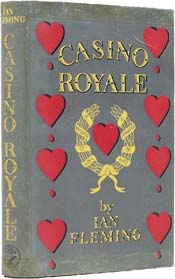
Another key question is how much should be spent on a book collection? Thanks to the Internet, it’s easy to spend $40,000 on a signed first edition of Casino Royale by Ian Fleming. Set a budget and stick to it. If you are collecting books that have prices out of your reach, be smart – spread your net into charity book sales, library sales, and thrift shops. Spot undervalued copies and snap them up. I met one collector who loved first editions from Fleming but could not afford them – instead he bought later editions and added facsimiles of first edition dust jackets. Facsimile jackets can be bought for $20. 
There are hundreds of ways to build an eye-catching collection without breaking the bank. A bookshelf filled with vintage Penguin paperbacks will impress anyone. Penguins published in 1936, the company’s first year, can be bought for under $5. Pulp paperbacks are also plentiful, fun to collect, and just as cheap. 
For more on book collecting, visit AbeBooks's online guide to book collecting. 
Read the original article HERE

Wednesday, December 12, 2012

Meet the Morgan Library: Don't Mind if I Do!

I've lived in New York City for about seven years now, and for all seven of them I have been saying, "Man, I really want to visit the Morgan Library."

This weekend, though, I finally went. (Why it took me so long to actually put that want into action, I will never know.) Armed with three of my fellow booklovers, we powered through every public exhibit in about two hours.

The main attractions: the Beatrix Potter special exhibit, "The Picture Letters," and the standard Pierpont Morgan's 1906 Library.

My reaction to said main attractions: *jaw dropping*

The Beatrix Potter exhibit was incredible--with letters, sketches, photographs, original merchandise, and more, the famed Peter Rabbit author's career comes to life before your very eyes. The delicacy of her lines, the graceful loops of her script--it was all just beautiful. I would have loved to get some pictures of some of my favorite pieces to share with you all but photography wasn't allowed.

Not only were the pieces themselves stunning, but it was a very educational trip, as well. My knowledge of Beatrix Potter herself, I'll admit, had previously been limited to what I "learned" in the 2006 Renee Zellweger film Miss Potter, so the exhibit was enlightening. Potter's personality shines through every piece on display--her solitary nature, her love of children, her subtle sense of humor, her passion for her work and perfectionism (she was one of the first "self-pubbed" authors, in fact).


And then...and then there was Morgan's actual Library and his little "reading room." The Library is filled with floors and floors of deliciously old-smelling, leather-bound books, rare manuscripts, ceiling murals, sculpture, and more.

Charles Dickens's original MS for A Christmas Carol, for example, was even on display just as we entered the room (with a placard noting that he delivered the MS to his publisher in early December and it was published by Christmas...I got a good chuckle at that one!).
I don't quite know what to say about it all as I was dazed as I walked around in awe.

The reading room was a different story. Dimly lit, tall-ceilinged, and covered in crimson and velvet, the lush room was gorgeous. I wouldn't want to read there myself--I need more comfort and less pomp and circumstance--but it was stunning in its decor. I was particularly impressed with the fireplace--so large I could step in it and throw some dust, shouting "Diagon Alley!" just for fun--and the two-floor book safe (yes, a BOOK SAFE).

*sigh*

Remind me to go back to the Morgan for more book love sooner rather than later, okay, friends?

Wednesday, October 3, 2012

Literary Labryinth in Los Angeles

Well, I know what I'm doing when I visit LA in November: going to the Last Bookstore to explore the Labyrinth.

Yes, you read that correctly.

Voted as one of the top 20 most beautiful bookstores in the world by Flavorwire, the independent bookstore in downtown LA is known for its spectacular space (it was a former bank!), selection of rare books, and memorable past events. And now, it will be known for its Labyrinth, a large structure containing 100,000 books, each priced at $1.

Mike, a blogger over at Franklin Avenue, shares some more details (and photos!):

The best bookstore in Los Angeles just got bigger -- and better. Downtown's amazing Last Bookstore, which we wrote about last year, has expanded dramatically into a new 6,100 square foot upstairs space that it calls the "Labyrinth."

The "Labyrinth" includes 100,000 books that are all $1 each. That's right. It's a bit of a treasure hunt, as the books aren't necessarily shelved in any particular order (although kids books seem to be grouped together in places). But that's perhaps part of the fun. If you want order, the books downstairs in the Last Bookstore's normal floor space are indeed cataloged. Upstairs, it's the wild west.


 See Mike's full article and images HERE


How cool! :)

Friday, October 22, 2010

What's That Smell--Bacon or a Book?

For the first time in months, I have a moment to breathe in the office. Granted, I have about ten things on my to-do list, but it's 4:15 on a Friday afternoon and I've been working my butt off all day. So, I'm giving myself ten minutes to surf the net.

And what did I happen on but something hilarious over at Richard Curtis's blog, E-Reads. I laughed-out-loud in my cubicle for about three minutes (that's very long in my world these days!).

Allow me to present you with one of Richard's oldies-but-goodies, "The Best of E-Reads: Aerosol Makes Your Nook Smell Like Crunchy Bacon":

From time to time we bring back some of the more popular articles and blogs posted on E-Reads. This one is from November 2009.
**********
A while back we wrote up a book lover who said she was reluctant to buy a Kindle “unless Amazon comes out with a special ‘book scented’ Kindle.” (See If They Can Make the Kindle Smell Like a Book, Maybe She’ll Buy One). It was all kind of a joke, but an enterprising manufacturer took it seriously enough to produce a line of aromatics simulating book scents. The aromas include New Book Smell and Classic Musty. The product is trademarked as Smell of Books™ and here’s how their website describes it:

Does your Kindle leave you feeling like there’s something missing from your reading experience?

Have you been avoiding e-books because they just don’t smell right?

If you’ve been hesitant to jump on the e-book bandwagon, you’re not alone. Book lovers everywhere have resisted digital books because they still don’t compare to the experience of reading a good old fashioned paper book.

But all of that is changing thanks to Smell of Books™, a revolutionary new aerosol e-book enhancer.

Now you can finally enjoy reading e-books without giving up the smell you love so much. With Smell of Books™ you can have the best of both worlds, the convenience of an e-book and the smell of your favorite paper book. Smell of Books™ is compatible with a wide range of e-reading devices and e-book formats and is 100% DRM-compatible.

Whether you read your e-books on a Kindle or an iPhone using Stanza, Smell of Books™ will bring back that real book smell you miss so much.

Among the five smells offered is “Crunchy Bacon”. This is a welcome novelty for noses jaded by such natural book fragrances as grass, leather, printer’s ink, and decaying paper. Hopefully, the Library of Congress, the New York Public Library and the Bibliothèque Nationale de France will invest heavily in shpritzing their collections with Crunchy Bacon. Some other but lesser known aromas associated with books are baked lamb shank, General Cho’s Chicken, and asparagus vinaigrette.

On a more scientific note, Henry Fountain of the New York Times reports on research to quantify old-book odors to help librarians preserve books more effectively. Fountain describes how conservators “analyzed the volatiles produced by 72 samples of old paper of different types and in varying condition from the 19th and 20th centuries, using liquid chromatography-mass spectrometry. They found that some compounds were reliable markers for paper with certain characteristics — high concentrations of lignin or rosin, for example, which make paper degrade relatively quickly.”

Read the full article HERE

While this post obvious takles the topic in a humorous and silly way, there's certainly something to what's being discussed. What book-lover doesn't get a rush from that somewhat-musty old-book smell?

A favorite pastime of mine (I say pastime because I haven't had any time in the present or even recent past to do this!) is wandering around rare book stores. Not only do I love to look at the brittle pages, the cover stains, etc. but the smell of a book carries with it so much history. Experiencing even a little piece of that history is thrilling to me, even if it is just in a scent.

I have a small, but lovely, collection of rare books myself and sometimes it makes me feel better after a bad day just to look at them, to think about their pasts--who touched them before me, who read them, if the book was a gift to its original owner, what part of the country it was read in, etc. etc.

One of my personal favorites is a Robert Frost greeting card (not the one at this link but for some nice history!)--it's one of merely a couple hundred copies printed by Joe Blumenthal, Frost's dear friend and printer. Normally, it wouldn't be all that exciting--it's just a greeting card. But this one was unique--inside the little card-book was a folded note from Blumenthal himself to the card's recipient, letting him know that Robert Frost dropped off his manuscript that day.

I don't know about you, but I think that's pretty damn cool.

And it smells too.

Not bad, just chock full of history.

Tuesday, July 20, 2010

Serial Book Thief Jailed...Again.

Move over, Markus Zusak, there's a new Book Thief in the house.

The big house, that is.

According to The Telegraph UK, Cambridge University alum William Jacques has been sentenced to three and a half years in jail for stealing over £1 million in antique books from a London Library:

Cambridge University graduate William Jacques, who stole £1 million of rare books in the late 1990s, drew up a "thief's shopping list" as he continued his life of crime.

He used a false name to sign in to the Royal Horticultural Society's Lindley Library in London before stuffing valuable books under his tweed jacket and fleeing, Southwark Crown Court in London was told.

Recorder Michael Holland QC told Jacques: "You have absolutely no intention of turning away from what seems to you to be an extremely lucrative and easy crime."

Such crimes "undermine and destroy parts of the cultural heritage that's contained within these libraries", the judge said.

The judge, who said Jacques had no mitigation, told him: "You are a Cambridge graduate and should know better, I suppose."

He went on: "This was a systematic and carefully-planned theft and you had prepared what, in my view, was a target list, from your research at that library, of books that were worth stealing.

"This was a theft in progress and the list referred to books worth tens of thousands of pounds more.

"Your entire motivation was commercial and you intended to make whatever money you could from the theft of these books despite their cultural value.

"The effect of your criminality was to undermine and destroy parts of the cultural heritage that's contained within these libraries and make it more difficult for those who have a legitimate interest in these books to gain access to them because libraries have to take inconvenient and expensive steps to stop thefts of this kind."

Jacques was "relying on the reluctance of library staff to challenge people" when they were used to dealing with members of the public whom they could trust, the judge said.

Jacques, 41, previously plundered more than £1 million of historic books from the UK's leading libraries in the biggest haul of its kind in British legal history.

The serial book thief, who escaped with some 500 extremely rare antiquarian books, hid behind a "shabby cloak of respectability" as he went on to sell them at auction houses in the late 1990s, judge Derek Inman said in May 2002.

Motivated by arrogance, greed and an obsession with money, the loner raided the nation's libraries, devastating their collections and damaging valuable works in an attempt to disguise their origins.

Even a four-year jail sentence, imposed by Judge Inman at Middlesex Guildhall Crown Court for 21 counts of theft, could not stop him.

In the latest case, the jury heard that Jacques would regularly visit the Lindley Library in Vincent Square, central London, which holds books, journals, pictures and art on practical gardening, garden history, plants and design dating back to 1514.

Read the rest of the article HERE

Huh. Talk about strange addictions. I gotta say that judge was pretty kick-ass.