Tuesday, January 31, 2012

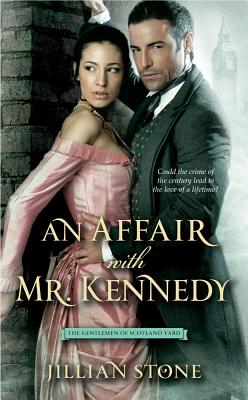
Happy Release Day! : AN AFFAIR WITH MR. KENNEDY by Jillian Stone

Today is a very special day. One of my favorite acquisitions from when I was working back in editorial, an awesome Victorian historical romance called An Affair with Mr. Kennedy, is hitting the shelves!

Not only is this great series--The Gentlemen of Scotland Yard--finally going to be shared with the world but it marks the author, Jillian Stone's debut into the literary world! Whee!!

Congrats, Jill!!

In honor of this wonderful occasion, Jill and I chatted a bit about the book, her writing, and what's next for the Yard Men:
DP: Thanks for being with us today, Jill! Tell me, what was the inspiration behind An Affair with Mr. Kennedy? How did the idea for the novel come to you? Did you write it with publication in mind?

JS: I knew I wanted to write a historical romantic suspense series and got to thinking about Scotland Yard detectives. It seemed to me that Yard men were always portrayed as bumbling inspectors, five moves behind Sherlock Holmes. So I thought, what if there was an elite group of detectives? So I began to do some research and found out that there was a division of Scotland Yard created in 1882 called Special Branch. I added a dash (as in dashing) of James Bond Steampunk and that was the start of The Gentlemen of Scotland Yard.

DP: As a debut author (with two multi-book deals with two publishing houses!), you were thrown into the industry with a vengeance. What surprised you most about the book business? What was the hardest thing to adjust to? What was your reaction to the often-shocking (and grueling) editorial process?

JS: Shocking and grueling, I think you summed it up well, Danielle! No writer’s workshop can prepare you for your first set of notes/edits. Once I picked myself up off the floor, and got a grip, I started evaluating what my editor wanted to see and what I knew was right for the story. Actually, I’m not sure how I got through it. But I survived and my favorite part of learning the editing process was when I realized OMG, the book is getting even better!

DP: Tell us a little about your writing process. Do you have a designated space to write? Rituals? Etc.?

JS: My process is I’m always writing because I’m not a fast writer. Plus, I enjoy small character details and world building, and that tends to take a lot of finessing. So I’m constantly at my computer when I’m in the middle of a book.

DP: Your hero and heroine--Zeno and Cassie--are such vibrant, fun (and sexy!) characters. If you were to cast them for a film version of the story, what actor/actress would you pick?

JS: Probably Clive Owen and Scarlet Johansson.

DP: When writing a novel, almost every author has to kill some of his/her darlings, as they say. Is there a scene, character, or plot (or something else!) that was particularly difficult for you to change or cut?

JS: I was asked to cut some love scenes to keep the suspense plot moving, which I did. The opening scene between Cassie and her mother almost bit the edit dust, but I held onto it by adding more heroine GMC. And it stayed in.

DP: You paint such a detailed and visceral picture of late-Victorian life in your book. How much research do you do? What are your favorite research tricks/go-to resources? Do you research as you go or study up before you begin?

JS: I do tons of research. I have a whole library of Victorian Age reference books. My favorite go-to trick is my subscription to OED online’s historical thesaurus. Invaluable. I research up front and also do a significant amount along the way. I never foresee everything I need, so I am often surfing the internet for some weird, esoteric bit of information late at night––and always on deadline.

DP: Who are some of your favorite authors? Books? Is there a book out there that you wish you had written? (Come on, all us writers have at least one. ;) For me, it’s Speak by Laurie Halse Anderson.)

JS: If you’re talking about women’s fiction or romance, I would have to go with Outlander by Diana Gabaldon. I have a whole range of favorite authors from Lewis Carroll to Gabriel Garcia Marquez to Frank Herbert and Phillip K. Dick.

DP: What’s up next for you and the Yard Men?

JS: A Dangerous Liaison with Detective Lewis. The second book in the Gentlemen of Scotland Yard series is a super fast-paced road story.

Here’s a little taste:

Five years ago, pure as an angel, hot as the devil, Raphael Lewis, did something unforgivable to Fanny Greyville-Nugent. Now, the handsome Scotland Yard agent is assigned to protect the wealthy industrialist heiress. Her life is in danger from the anti-progressive Utopian Society and its leader, Bellecote Mallory, who has tumbled into madness and gone underground. One by one, the diabolical Mallory is executing prominent members of the industrialized world––by their own machines––and Fanny is next in line. Pursued by Mallory’s henchmen, Rafe and Fanny are on the run from Edinburgh to London by train, landship and submersible! Racing against the clock, they are carried away by their passions, but can Rafe ultimately redeem himself?

To further celebrate the release of An Affair with Mr. Kennedy, I just so happen to have an extra copy of the new book to send along to a random reader....

So, leave a comment by 5pm EST on Friday, Feb. 3 about the book , for Jill, or with your own casting choices for Zeno and Cassie, and you just may be that reader!

Monday, January 30, 2012

Second Time's the Charm for "A Wrinkle in Time"

I first read Madeleine L’Engle’s A Wrinkle in Time in my fifth grade English class. And I hated it. No matter what I did, I couldn't get into it. I didn't care about the heroine Meg Murry. I was bored with the writing. I also hated pink, so the edition we read made my head hurt like whoa.

I don't know what my deal was. I devoured books at that time in my life. (Well, I've always devoured books, really.) But for some reason, A Wrinkle in Time was not my cup of tea.

About five years ago, though, I decided I needed to read it again. Give it another try with fresh eyes and an open mind. And, of course, I adored it the second time around. Maybe as a kid I had been subconsciously rebelling against the fact that I totally related to Meg, that I wasn't one of the "cool kids," and didn't feel like I fit into my reality. Maybe I just wasn't ready to start liking science fiction--I had been so wrapped up in contemporary novels about babysitters and high schoolers and the like. At the time, maybe I just couldn't see it.

But whatever the reason, my mind was changed. Which is quite handy given that it means when I saw an article on NYtimes.com about the novel, I was actually interested in reading it. (It's awesome, by the way, though lengthier than I usually post)

And you know what that means...I can now share it with you:
Bookish girls tend to mark phases of their lives by periods of intense literary character identification. Schoolgirls of the ’70s had their Deenie and Sally J. Freedman and Margaret moments, muddling through adolescence in the guise of one Judy Blume heroine or another. And for almost a century and a half, girls have fluctuated between seasons of Amy and Meg and Jo March, imagining themselves alternately with blond corkscrew curls, eldest sister wisdom or writerly ambitions.

But for those who came of age anytime during the past half-century, the most startling transformation occurred upon reading Madeleine L’Engle’s Newbery Medal-winning classic, “A Wrinkle in Time,” which celebrates its 50th anniversary this year. It was under L’Engle’s influence that we willed ourselves to be like Meg Murry, the awkward girl who suffered through flyaway hair, braces and glasses but who was also and to a much greater degree concerned with the extent of her own intelligence, the whereabouts of her missing scientist father, the looming threat of conformity and, ultimately, the fate of the universe.

Meg Murry, in short, was a departure from the typical “girls’ book” protagonist — as wonderful as many of those varied characters are. Meg was a heroine of science fiction.

In 1962, when “A Wrinkle in Time,” after 26 rejections, was acquired by John Farrar at Farrar, Straus & Giroux, science fiction by women and aimed at female readers was a rarity. The genre was thought to be down-market and not up to the standards of children’s literature — the stuff of pulp and comic books for errant schoolboys. Even today, girls and grown women are not generally fans. Half of 18- to 24-year-old men say that science fiction is their favorite type of book, compared with only one-fourth of young women, according to a 2010 study by the Codex Group, a consulting firm to the publishing industry. And while a sizable portion of men continue to read science fiction throughout their lives, women don’t. Thirty-two percent of adult male book buyers are science-fiction fans compared with only 12 percent of women. When Joanna Russ, one of the few successful female science-fiction writers, died last year, her obituary in The New York Times referred to her as a writer who helped “deliver science fiction into the hands of the most alien creatures the genre had yet seen — women.”

“A Wrinkle in Time,” the first in a trilogy that was later extended to include two more books, also defied the norm. Though a major crossover success with boys as well (with more than 10 million copies sold to date), the book has especially won over young girls. And it usually reaches them at a particularly pivotal moment of pre-adolescence when they are actively seeking to define themselves, their ambitions and place in the world.

“Part of what made it seem so liberating to so many girls is that it allowed those with an analytic mind and an interest in the pursuit of science to read about a subject that at the time was not perceived of as a suitable course of study for girls,” said Leonard Marcus, author of a biography of L’Engle, “Searching for Madeleine,” to be published this fall. “At the same time, at its core it’s about a girl’s love for her father, and that emotional level transcends the genre aspect of the book.”

[...]

Perhaps it is this softer element that distinguishes “Wrinkle” from its rocketry and light-saber brethren. But that doesn’t make the book any less weighty or challenging. In her introduction to a 2007 edition, Anna Quindlen, an enthusiast since childhood, confessed, “The truth is, I’m not a fan of science fiction, and my math and physics gene has always been weak.”

L’Engle’s book shies away from neither topic. On meeting Meg, we learn she can perform square root functions in her head — a mark, not of wallflower status, but of moral distinction. Still, Meg harbors doubts about her own intellectual abilities, and her exacting expectations rub off on the reader. If anything, the book enchants readers who might not entirely grasp its concepts with the delight in not knowing; the realization that even the most know-it-all kids do not, in fact, have all the answers and that certain questions are worth asking.

“I loved Mrs Who’s cryptic quotations, and the math that went right over my head and the fact that Charles Wallace had powers I was always struggling to understand,” said Rebecca Stead, whose Newbery Medal-winning novel, “When You Reach Me,” was in great part a homage to “A Wrinkle in Time.”

L’Engle, who was born in 1918 and grew up a child of privilege in New York City, struggled academically at her private school, though she later graduated cum laude from Smith. She first got the idea for “A Wrinkle in Time” after reading Einstein’s writings on relativity. “I used a lot of those principles to make a universe that was creative and yet believable,” she said in an interview with her publisher before her death in 2007.

Of course, science fiction is not only about science; it is also often deeply informed by politics, and can be a vehicle for commentary on the complex effects of progress in all its permutations — medical, political, technological. Russ, for example, a graduate of Yale, wrote books infused with feminist messages and digressions on philosophy. “A Wrinkle in Time” can be read as a warning against communism. L’Engle, an active liberal Episcopalian who spent many of her later years as a writer in residence at the Church of St. John the Divine in New York, tended to write allegorical works in which, as in the books of C. S. Lewis, good inevitably triumphs over evil, a message as likely to appeal to girls as it is to boys.

What is it then that makes girls averse to science fiction? Could it be the pronounced boyness of the covers — the same signal that deters girls from switching to Superman after their Betty and Veronica days have passed? Science-fiction books, whether technologically elaborate, intergalactic stories by the likes of Arthur C. Clarke and Hal Clement or the so-called “soft” science fiction of Ray Bradbury and Philip K. Dick, often wear dark washes of black and navy blue with 3-D fonts and brutal images of fire and destruction.

Yet there isn’t anything inherently unfeminine about science fiction. Some might say the dystopic fantasy, apocalyptic tales and paranormal romance so popular with today’s teenage girls are actually couched “girl-friendly” variants of science fiction. Perhaps. But why should science fiction proper be any less welcoming to girls? It may be simplistic to suggest that reading science fiction will lead women to pursue careers in chemistry and quantum physics and information technology. But then, how many female authors say they were inspired to become writers because of Jo from “Little Women”?

Surely we don’t mean to imply that science fiction, or science, is really just for boys. It is, after all, Meg’s microbiologist mother, Katherine Murry, rather than her rescued father, who later in the series wins the Nobel Prize.

Read the entire article HERE

Friday, January 27, 2012

Guest Blogger, Alex Christopher: The Artists’ Book - Beauty Between the Bindings

As a new resident of New York City, I have spent the past several months enchanted with the sensory overload the metropolis offers. Some of the greatest experiences have come from simply seeing something for the first time: the towering skyscrapers, the arguing taxi driver, the old woman feeding pigeons (sorry for mentioning those awful creatures, Danielle!), the expanse of culture and creativity.

Like most newcomers, I have made an effort to visit museums to view the many pieces of fine art that I had only seen in books or on blogs. Viewing a piece of art for the first time is a breathtaking experience, particularly for an artist like myself. People can be brought to tears simply by looking at a painting. In a new city, with new things to see everyday, I can experience this over and over again. But eventually, you become immune to the stunning landmarks and the sweeping canvases. That’s the saddest thing about art. It’s the risk you take when purchasing an incredible painting or living in a city like New York--the lack of constant appreciation. Eventually, you get accustomed to striding right by it on your daily routine.

This is when the artists’ book offers more. The turning (or in many cases, unfolding) of a page reinforces what is called the “First View.” The discovery of what lies on the next page is an experience in itself, no matter how many times you go through it.

Of course, writing itself is an art form, and writers are in fact artists, but I’m not guest blogging to discuss that. The artists’ book is a developing genre of art that is gaining global recognition. The audience can see and touch every step of the process—the handmade paper, the letterpress printing, the threading that holds the pages together. Anyone viewing the artists’ book can comprehend its well-executed craft and concept.

Oftentimes, the book’s price point reflects the artistry of a book—you won’t find artists’ books for $24.95 at Barnes and Noble! An artist makes a specified quantity of an original book, called an edition. Editions can be anywhere from ten to hundreds of copies, and it is usually noted somewhere what number each book is (such as 36/250). The quantity produced (and of course the reputation of the artist) is a huge factor in the pricing of an artists’ book, which can sometimes reach the $10,000s and higher.

As book art is a developing field, many of the pieces are incredibly innovative. A standard beginning point is the eight-fold book. It’s actually a great activity to do with kids. With just a cut down the middle of the page and a series of folds, you have a book! (Check out the Brown Paper Bag 8-fold Activity.) While it would be easy to make this post a how-to guide for fun homemade books, I’d like to share with you a professional example.

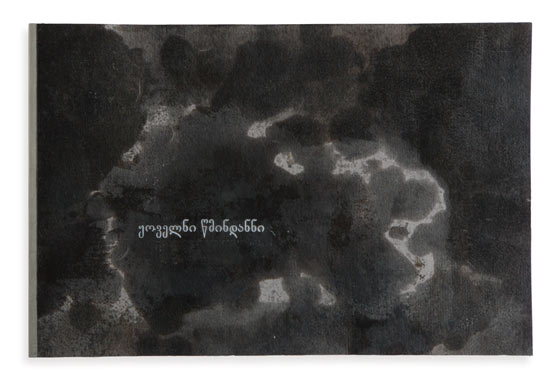
I turn to a favorite artist of mine, Clemens Tobias-Lange. His stunning book, Ohne Wolken (Without Clouds), was the impetus for my own interest in the field. Each fragile page is made of fine Japanese handmade paper. It was intended to recreate the action of flying in a plane: take-off through landing, and the horizons along the way. The center spread is the most breathtaking, with a striking gradient from clear/white to bright blue. Each cover flap bound around the pages is made of spinnaker cloth (yes—like the kind used for boat sails). The only text within the book is in the very front and very back—a poem by Qu Yuan called “Li Sao” and is included in German and Chinese. This is incredibly fragile, and as many artists’ books do, it comes in a case; it is custom-designed plexiglass that the book can slide into. Tobias-Lange made only 30 copies of this book, and it is highly valued among collectors and libraries.

I recommend looking further into this field of art, as it really challenges the audience to approach a piece intellectually and to see the value of the First View. One great resource would be to look through the exhibitors (or attend an event if you can!) for the Codex Foundation.

Just think of all the possibilities books can hold for you!

About the blogger: Alex Christopher is a Californian transplant to New York City, where she works as a book publicist (quite near the cube of the lovely Danielle). Through double majoring in Global Studies and Art Studio, she became well versed in the practices of relief printing on letterpress, papermaking, and book arts. She can be found on Twitter: @alexthelady.

Wednesday, January 25, 2012

Thoughts on Love from Kahlil Gibran

Just a week after my dear friend told me that I should read her favorite book, The Prophet by Kahlil Gibran, I saw it on my boyfriend's bookshelf. Of course, I was reading about four books at the time already, so it went from his shelf to the top of my to-read pile.

Today, though, I cracked that baby open on my subway ride home from work. It's a lot to take in at once--thoughts on love, family, marriage, work, etc.--but there have been some very inspiring moments and phrases that have stuck with me.

The section on love (naturally--also the first section) is my favorite so far--powerful and true, I want to keep reading it to myself so that it sinks in deeper and deeper. And I want to share it with you all:

When love beckons to you, follow him,
Though his ways are hard and steep.
And when his wings enfold you yield to him,
Though the sword hidden among his pinions may wound you.
And when he speaks to you believe in him,
Though his voice may shatter your dreams as the north wind lays waste the garden.

For even as love crowns you so shall he crucify you. Even as he is for your growth so is he for your pruning.
Even as he ascends to your height and caresses your tenderest branches that quiver in the sun,
So shall he descend to your roots and shake them in their clinging to the earth.

Like sheaves of corn he gathers you unto himself.
He threshes you to make you naked.
He sifts you to free you from your husks.
He grinds you to whiteness.
He kneads you until you are pliant;
And then he assigns you to his sacred fire, that you may become sacred bread for God's sacred feast.

All these things shall love do unto you that you may know the secrets of your heart, and in that knowledge become a fragment of Life's hear.

But if in your fear you would seek only love's peace and love's pleasure,
Then it is better for you that you cover your nakedness and pass out of love's threshing-floor,
Into the seasonless world where you shall laugh, but not all of your laughter, and weep, but not all of your tears.

Love gives naught but itself and takes naught but from itself.
Love possesses not nor would it be possessed;
For love is sufficient unto love.

When you love you should not say, "God is in my heart," by rather, "I am in the heart of God."
And think not you can direct the course of love, for love, if it finds you worthy, directs your course.

Love has no other desire but to fulfil itself.
But if you love and must needs have desires, let these be your desires:
To melt and be like a running brook that sings its melody to the night.
To know the pain of too much tenderness.
To be wounded by your own understanding of love;
And to bleed willingly and joyfully.
To wake at dawn with a winged heart and give thanks for another day of loving;
To rest at the noon hour and meditate love's ecstasy;
To return home at eventide with gratitude;
And then to sleep with a prayer for the beloved in your heart and a song of praise upon your lips. (Gibran, 11-14)

(Gibran, Kahil. The Prophet. New York: Alfred A. Knopf, 2007.)

Turkey Troubles in Deadwood, S.D.

BAHAHAHAHAHA!!!

That is all.

Thank you Huffington Post:

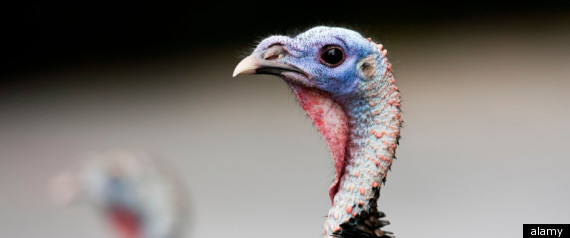
DEADWOOD, S.D. -- Authorities in Deadwood, S.D., investigating an apparent break-in at a public library were surprised to discover the culprit: a 20-plus-pound turkey.

Deadwood Police Sgt. Ken Mertens says he didn't see any footprints near the broken window and figured a snow blower had tossed up a rock.

Mertens says a closer inspection revealed the wing-flapping culprit. And, he says, "that turkey wanted back out that hole."

Mertens and Chaney-Moodie's husband, John, spent 20 minutes trying to round up the intruder before placing a blanket over its head and escorting it outside.

The bird fled on foot.

See the original post HERE

Friday, January 20, 2012

Guest Blogger, RossH: An Intro to Webcomics

I was talking to Danielle a few weeks and sharing some ideas I'd had about Christmas gifts, I sent her a link to a shirt on TopatoCo, which she later posted here, along with some other choice materials from the site. After sharing our favorites of the various witty t-shirts, we got to talking about the webcomic business, and she asked me to put together a guest post for the blog to give a bit of background on this unique slice of the publishing universe.

Many of you may be regular readers of webcomics—they definitely make up an important part of my morning—but this post focuses on the business side of webcomics, rather than simply sharing a list of my favorites (which include Questionable Content, Penny Arcade, Wondermark, A Softer World, and more).

To begin with, the basics: Virtually all webcomics are free to the reader. There was a period of time when there was some interest in the concept of "microtransactions" to support webcomics, meaning that readers would seamlessly pay a tiny amount of money to the writers and authors of a webcomic as they read it (maybe a cent a page), but this concept never really took off for webcomics—or most other content types. The transaction costs of moving this money around outweigh the profits of the plan , and can be a serious barrier to potential readers just out of sheer inconvenience. So, today, you can read the full runs of most all webcomics for free without having to input any personal or payment information before diving in.

But despite the fact that the core product of most webcomics is completely free and open, there are a number of people who have managed to make a reasonably successful living writing and drawing webcomics. Wikipedia has a list of "professional webcomic artists," folks who are supporting themselves through their work producing webcomics. And that doesn't just mean making enough money to keep yourself in ramen. Penny Arcade, one of the earliest and most successful webcomics, has built an empire—a multi-million dollar business that now includes a web-TV show, a biannual video game convention that attracts tens of thousands of fans, and more. Not bad, for comic that is often obscure to those who don't follow the minutia of the video game industry and is frequently far more filthy than the newspaper comic strips many of us grew up with.

So, how does this work? How can these comics manage to build strong businesses while giving away the heart of their work?

Ad revenues are certainly a piece of this, and there are several ad networks tailored to supporting webcomic sites. And some (again, most notably Penny Arcade) can sell access to their special niche audience for well above market rate, and even partner with gaming companies to develop comics specialized for a new game launch. In doing this, Penny Arcade is supported by a strong perception of integrity—they advertise and work with games that they themselves enjoy and want to promote. Many webcomics use ad networks to help bring in sales--Project Wonderful and IndieClick being two of the most common for this purpose.

Of course, in the end, how much profit a webcomic can make through advertisements is dependent on the popularity of the comic itself and rate of traffic to the site. Jeph Jacques, the author of Questionable Content and internet cartoonist, for example, commented on Reddit.com that he makes 50% of his revenues from ad sales. So, where does the other 50% come from?

For Jacques—and for most successful webcomics—merchandise sales make up at least half of the pie. Many webcomics sustain themselves in some large part based on t-shirt sales, often featuring comedic elements drawn from or inspired by their most popular works. Some self-manage this process, and others work with third-party vendors (including the aforementioned TopatoCo, a company run by webcomic artist Jeffrey Rowland of Overcompensating, Wigu, and other comics that is tailored to the needs of webcomic t-shirt sales).

In support of both of these revenue streams, and in general for building and maintaining a fan base, many webcomic creators are highly engaged on Twitter, both with fans and with other creators. This provides a strong relationship between a creator and their audience that evolves with day-by-day postings of new comics and can contribute
to helping identify potential t-shirts and more.

As with everything, these models are not without their detractors. Plenty of syndicated newspaper cartoonists (which, pre-web, was the only real route to success for a comic creator) complain that webcomic producers aren't selling their comics, they're selling shirts, and in the process devaluing the art form. And, from another direction, a regular strain of discussion among webcomic producers themselves admonishes new producers who seem to focus on the business side of things before they have established a solid comic.

But ultimately, this is a model with an extremely low cost of entry that has empowered a set of creative professionals to follow their interests and build self-sustaining publishing businesses off their work. They have recognized that their core product is difficult to sell, and have thus developed ancillary income streams around it. This kind of business model begs the question: What can be learned here for traditional book publishing, which typically focuses on selling the book itself, or giving away the book in hopes of "building an audience" to later be able to sell books? Can comics show a model for a middle ground, in which an audience can actually be turned into customers in a different way?


About the Blogger: RossH is a researcher and and consultant focused on higher education and library policy. And, of course, a fan of webcomics. You can find him on Twitter: @rossh.

Thursday, January 19, 2012

*sings* I'm a Big Girl Now! (Audiobook style)

Last weekend, I spent 11-12 hours in the car driving to and from Virginia to visit Allison Pang. (We had an AWESOME time, in case you were wondering! :-p) I hadn't done a drive that long solo in quiet some time and was a bit concerned about getting tired and, well, falling asleep at the wheel. Usually this fear will instigate the creation of numerous playlists for my "singing" pleasure. But this time, I decided to try something different.

I was going to listen to my first...audiobook....ever.

Yes, I know. It's shocking.

Me? Listening to an audiobook? I had no idea what to choose or even how to choose. So, the first thing I did was look for the best deal I could find. And that was to go with Audible.com. I don't know if this is actually the best deal, but there was a promotion so hey, it worked for me.

I kicked around the site, trying to decide what kind of book I wanted. I was leaning away from fiction for the first time in my life, fearing that I would hate the experience and then be stuck listening to someone read dramatically to me and driving me crazy in the car or I'd have thrown away some much-needed cash on something I didn't use. I know! I thought. I'll get something guaranteed to be funny so it keeps me laughing out loud!

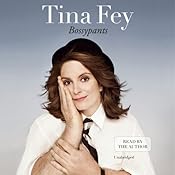
I listened to the samples on a couple different options and then...then I found it: Bossypants, written and read by Tina Fey.

As soon as I started listening I knew it was the right choice.

Brilliantly crafted, thematically balanced, and filled with wit, sarcasm, and heartfelt honesty--I was truly impressed with Fey's memoir. Her delivery being spot-on was kind of expected, of course, and she did not disappoint. What I didn't quite expect though was how down-to-earth Fey seems, how I could relate to so many of her own personal trials and triumphs. Not to say I've accomplished anything close to what she has; my point is just that she's real. She talks about real issues, real feelings, and gives such great insight it's empowering.

I must say Bossypants was the best book I could've picked to kick-off my audiobook-listening "career."

Next up? I'm not sure yet...I'm considering Jane Lynch's memoir or something of that ilk.

I am, as always, open to recommendations!