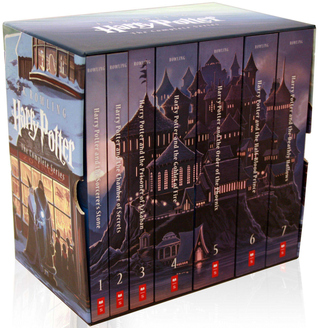
Let me give you a hint. It's one word...
Okay, it could easily be lots of words if you want to get colorful...
EGO.
As an editor, I have experienced the negative effects of the overinflated writer's ego more times than I can count. I have been yelled at, told I'm bad at my job, called insensitive and ignorant, had my own and my editors' skill and character attacked, received unsuccessful attempts at manipulation by writers using mental and physical health issues to get me to allow their behavior and consider it acceptable, and countless other things. Anyone who knows me at all, knows I deserve none of these things. Still, it has happened, and I have had to waste my precious time, energy, and own emotional well-being defending myself and my team to narcissistic, egotistical writers, some of whom could be great writers if it weren't for their ego, and others of whom are not and will never be very talented/skilled in this particular arena.
Sadly, I am certainly not the only one who goes through this. It happens regularly. And to draw attention to the issue, Lilyn G. of the website Sci-Fi & Scary shared her most recent experience in the post "This is NOT a Review of Hell’s Shadows by Dean Klein" (this post was updated on May 13, 2019, and is a bit out of order, but if you read it through, you'll catch on quickly. Do it. It's worth it.):
So for those of you that have already read this I won’t make you read through the whole thing to get to the update. (Don’t worry, his e-mail wasn’t 9 screenshots long this time.) This is how Klein chose to respond to me (and my follow-up response.)


There was another e-mail where he said “You put it on the web, knowing the damage it would cause. You didn’t have to do that yet you did. You deliberately defamed my book."
As he seems unable to get any sort of point here I have blocked him.
For those just entering the scene…
Sci-Fi & Scary has a clause in their review policy that states that if you act like a whiny ass child, you will be treated as such. Furthermore, it states that all communications once you have started acting like said child will be posted publicly.
“If you submit to this site, you are saying that you promise you will be an adult if you receive a negative review. You WILL not attempt to harass or coerce the reviewer about the review that you received. You will not contact them at all about the review that you received. IF YOU DO:
Your communication will not stay private. It will be posted on the site for the world to see, and shared to social media. Your whinging and/or harassing will be publicly displayed, as will any follow-up whinges about it being posted publicly.
If you act like a child, you will be treated like a child."
[This is] our review policy. Don’t believe me just look.
In the months (years?) since I instituted this policy, I have never had to use it before. Not until now. There’s always someone, isn’t there?
Klein has made a few mistakes here. Firstly, he used his (supposed/self-claimed) anxiety as a crutch, sending us a few emails asking where the book was on the reviewer's list and such. (Normally I wouldn’t place the emphasis on supposed/self-claimed, but you’ll see why I did in just a bit.)
Authors: Don’t use your mental health as a crutch when seeking reviews. It is okay to suffer from mental health problems, and it is definitely okay to talk about them. However, doing it when seeking a review is seen as trying to influence reviewers to be nice to YOU (aka be nicer about their review of your books). This is NOT GOOD PRACTICE. I say this as someone who deals with anxiety and takes meds for it almost daily. (Credit where it’s due, it’s Jim from Gingernuts of Horror who put it more clearly than I could have when this part of the convo popped up on Twitter.)
(Now, because of his claimed anxiety and we understand that, Sian had two other people go over her review to make it as nice as it could be while still be truthful…but more on that later.)
Secondly, when I nicely sent him an e-mail out of consideration for his anxiety, the response that I got was off the charts.
Here’s the email that I sent him.

I apologize for the 9 screenshots to come, but that’s how many it took me to capture all of his e-mail for everyone to see. Now, there’s some overlap in these because I wanted to make sure nothing was missed,but STILL. No petulant response to the notification of a bad review should ever happen, and it should DEFINITELY never be this long!!


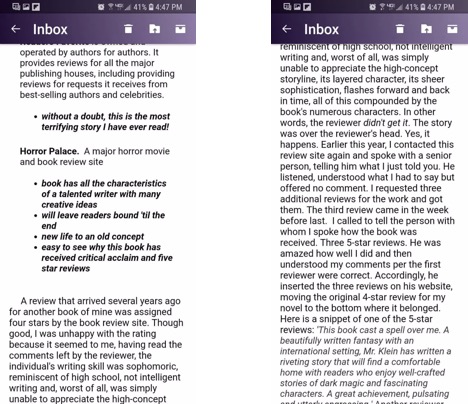


I’ll just wait here for a moment while you all take this in.
…. kind of amazing, am I right? After reading this, you totally want to buy this man’s book and read it, right?!
But wait, dear readers! It gets BETTER.
In the author’s note, Klein writes:
“And please note this – both novels were read by an entire Barnes & Noble store management team and were deemed so good by the two assistant store managers and the store manager that they were ordered and shelved right next to the works of Mr. King himself.”
Dean Klein, author’s note for Hell’s Shadows
I don’t… I don’t know how to break this to you, dear author, but the mostly likely reason you were shelved right next to “Mr. King himself” is that your last name is KLEIN and most stores do tend to shelve things alphabetically in their respective genres. KL comes after KI so… yeah. Draw what conclusion you will there but I think most of us can figure that one out.
I’m not done yet.
There’s also the fact that this fine fellow also tends to be a complete toe-rag to those who have dared to give him a negative review on Amazon.

Now, this is absolutely NOT A REVIEW of Dean Klein’s Hell’s Shadows book, but if it were a review, then it would say this:
Title: Hell’s Shadows | Author: Dean Klein | Publisher: CreateSpace | Pub. Date: 16 November 2012 | Pages: 426 | ISBN: 1480279102 | Genre: Horror | Language: English | Triggers: None | Rating: 1 out of 5 | Source: I received a copy of this book for review consideration
Hell’s Shadows Review
Robin and Gil are married and want to buy a house, unfortunately they don’t like any Estate Agent Elaine shows them until she shows the uninhabited, probably haunted ‘Parsons Knoll’. Parsons Knoll isn’t overly happy to have potential new tenants so tries to kill Elaine. Naturally, Gil and Robin then must buy this house.
The premise for this book could really have been something, and I think with some heavy editing and maybe cutting out 200 pages of the book, could have had the potential to build tension well. This book promises to be the scariest haunted house book you will ever read, yet unfortunately falls short of this promise due to a heavy reliance on dialogue and repetition the whole way through. For example, Robin would find out some information from Alvina which might be a few pages worth of potentially interesting development, she would then feed it back to Gil in almost as many pages (or so it at least felt).
The characters were fickle, especially Robin, who literally spent every other page changing her mind as to whether or not she wanted to stay in the house or not. Gil was patronising and a bit sexist and their relationship with the police was quite unbelievable. I didn’t really like any of them and though that isn’t always necessary it would have helped Hell’s Shadows a good bit. Alvina, this old woman (who’s like over 100 years old so knows loads about the house) accent is too much and it cast a shadow on the read and her character for me.
Unfortunately, for the first third of Hell’s Shadows the writing failed to engage me. The majority of sentences start with ‘But’ which is something that we all fall prey to sometimes, but just doesn’t make for a good read. It gets a bit better in the middle, but the problem reappears near the end.
Hell’s Shadows has potential, but again it is severely hampered by problems that could be fixed by the attention of a good editor. As it stands it is a painfully slow read that doesn’t allow the premise to shine like it could have. (Sometimes 100 pages feels like 3, and sometimes 3 feels like a hundred. Bookworm relativity.)
Unfortunately this was not a pleasant reading experience, but I do hope the author continues to work hard at refining his skill.
1 star.
That is the review that would have been posted. Because we do try to be nice on occasion. The following is (posting with Sian’s permission) the original review had we not been so nice:
Robin and Gil are married and want to buy a house, unfortunately they don’t like any Estate Agent Elaine shows them until she shows the uninhabited, probably haunted ‘Parsons Knoll’. Parsons Knoll isn’t overly happy to have potential new tenants so tries to kill Elaine. Naturally, Gil and Robin then must buy this house.
The premise for this book could really have been something, and I think with some heavy editing and maybe cutting out 200 pages of the book, could have had the potential to build tension well. This book promises to be the scariest haunted house book you will ever read, yet fails to build any tension and drama due to a heavy reliance on dialogue and repetition the whole way through. For example, Robin would find out some information from Alvina which might be a few pages worth of potentially interesting development, she would then feed it back to Gil in almost as many pages (or so it at least felt). Yawn.
The characters were fickle, especially Robin, who literally spent every other page changing her mind as to whether or not she wanted to stay in the house or not. Gil was patronising and a bit sexist and their relationship with the police was ridiculously unbelievable. I didn’t really like any of them. Alvina, this old woman (who’s like over 100 years old so knows loads about the house) accent is gimmicky and cheapened the read and her character for me.
Now, the plot is bad and the characters are bad, but at least the writing is engaging? Unfortunately not, for the first third of the book, the majority of sentences start with But, for absolutely no reason. I thought this had gotten better later on but maybe I just started to notice it less. Then they started appearing again. Have you ever read 100 pages of a book, and felt like you had made incredible progress, and then looked down at the page count and realised you had actually only read 3? That’s what this entire book felt like. I don’t usually DNF reads but this book has taught me that should be the option I choose in future.
1 star.
So, I said there were a few things that Dean Klein had done wrong. What was the final thing, you ask?
The final thing was that he fucked with my crew. You do NOT talk down to me and my team like that and get away with it, you pathetic excuse for an over-privileged and underwhelming rectal sore masquerading as a man. I don’t need a college degree to spot an asshole, nor one to understand how not to be one.
See the original post HERE
The response you are looking for is WTF?!
But yes, people do behave like this. I have had similar experiences. And I know you probably want the specifics of those experiences now that you've seen what can happen, but I will not be sharing them for several reasons:
A) I don't have a clause like the one in the above article,
B) the only time things between me, my team, and an author are not confidential is if I have to take something to a law enforcement or a lawyer or if I am given permission from an author to share something,
(Note: Yes, I have had to take someone to court. Yes, it was a pain in my ass. And yes, I would still do it again if I had to or if anyone ever defamed or libelled me. So don't test me. LOL)
C) these are toxic experiences and people I have any interest in holding on to and have broken ties with,
D) I'm just not an asshole.I also like to believe most people eventually grow and realize the error of their ways. I won't be working with them ever again, but I also am not going to name names and potentially affect their future opportunities. In some cases, I do believe in calling people out, just as Lilyn did in the above piece, and I respect her for supporting her staff and doing so, especially since the author in that scenario kept escalating things and was attacking even readers in a public forum and was refusing to let up. It was the right way to handle it in that situation. But in my cases, the guilty parties already know who they are and what they did, and are not in my life anymore. And I sincerely hope that I never have to make anything public in order to protect others from the same abuse.
All that said, it's unbelievable to me how highly some people think of themselves and how uncivilized, unprofessional, and just plain horrible people can be to you when you dare disagree with them or point out something that could be improved. I am not saying a writer can't be confident, of course; a writer needs to be confident. But they also need to be realistic, self-aware, and respectful of others.
Sort of like all people in life in general need to be...
For the most part, writers who work with editors do learn this over time, if they don't start off that way. An editor is there to help make a book the very best version of itself, and that often means swallowing one's pride and being open to constructive criticism, even when it results in a little bit of temporary heartache and having to kill some of one's darlings, as we say. As creators of any piece of work, we can't see our own creations objectively, whether we think we can or not. Not right away. We need professionals to help us see through the fog. We might not agree with them even after that fog clears, but more often than not, after a little time, we see what said professional meant and why. Only then can we tweak and revise to find that sweet spot.
That end result is why editors, reviewers, and the like exist at all. We do not exist to just pat you on the back and praise you. We are paid (sometimes haha) to find the weaknesses and make sure you see them, as well as help you learn different ways you could address said weaknesses. If that's not what you want, you shouldn't hire an editor, request reviews, or probably even put a book out there at all because just as someone somewhere will like it, someone somewhere will dislike it. And artists of all kinds have to accept that and be respectful of others' opinions.
However... Sometimes people just don't. Sometimes a writer thinks they are perfect and because Mr. X thought it was brilliant, Ms. Y said it was a revelation, and Dr. Z told you it was engaging, doesn't mean it will be to everyone. Just like not all people have the same sense of humor, nor react the same way to things, nor have the same feelings and even morals. And just because a person--including the writer himself or herself--believes something does not make it so. Besides, a writer wants as many people as possible to enjoy their work, right? For that to happen, it requires listening to and considering the constructive criticism of people whose opinions are different from yours, who have pinpointed examples and explained how a reader could react to something in your manuscript. It's a new set of eyes, a fresh angle on something you are way too intimately attached to and know way too much about to see clearly from another person's perspective.
I'm not saying a writer has to take all the suggestions that are made to him/her. If they did, they'd have a Frankenstein book on their hands because, again, there are a million different opinions out there. But when you reach out to a professional, an expert in a field with experience and training, you should at least be open. You can't shut it down immediately. You can't take it as a personal attack. You can't claim your own opinion is fact. You can't then attack us for trying to help you, for doing the job you asked us to do.
If you think about it, attacking us for critiquing your work and doing our job is actually you doing to us exactly what you feel we've done to you. You are attacking our life's work, belittling us, hurting us, and so much more. Except we haven't done that. And if you feel we have, it certainly isn't intentional while your attack is. Because believe it or not, just as we expect you to be respectful to us, we are respectful of you. We carefully word our comments, we rework our revision letters to soften any hard blows so they are actually more helpful to you, we have others even read our work sometimes to ensure we are coming across the way we intend and are not. Yes, sometimes, things come out wrong even after all those steps. Certain people are more sensitive to specific things than others, too, which we can't always know, and everyone has different triggers. So we try our best.
We aren't going to sugarcoat every single thing for you, though. If we do, it's doing you and your project a disservice, especially if that candy coating makes you think a comment isn't significant when it is really a major issue that needs to be addressed one way or another. We will do our best to share our thoughts, responses, experiences, and expertise in a way that gives it the importance it needs and to get our point across most effectively based on what we do know about any given author, but we are human, too. And we have you and your book's best interest at heart at all times--it's why you hired us. It's what we do.
Remembering all these things and being respectful of your editors, reviewers, and readers is the only way you will ever succeed in this industry.
And what do you know? Doing that in life overall is also the only way you will ever truly be happy (and a good person).







 There’s a Harry Potter hardback box set that comes in a special chest and sells not as a route to cheap and quick, but as a route to one-off and exquisite. A technology that publishers have avoided and frowned upon is one that they could instead use to cater to that overlap in our Venn Diagram.