Showing posts with label publishing. Show all posts

Wednesday, September 6, 2017

Hello, It's Me.

So it's been over two years since I've posted directly on the Reading Between the Lines blog. I won't bore you with the details, but life has been pretty all over the place. In fact, a friend of mine recently came to this site for the first time and promptly informed me that I haven't blogged in a really long time.

I was immediately embarrassed, of course, but it got me thinking. And I realized that even though my life is insane and deadlines I deal with as an editor are sometimes ridiculous and incredibly stressful, I miss blogging, even if it's merely to share an article--something I also haven't even had much time to do. But maybe it's worth carving time out for. Life has changed so much in so many ways that I haven't been very good about letting myself have "me time." It's something I really need to work on.

In that spirit, I recently started going back to yoga (but very light, gentle yoga and restorative yoga only once or twice a week due to various medical conditions--they account for some of aforementioned craziness). And now I'm going to attempt to get back on the blogging horse, since really, it's an easy thing to do if I just do it.

Now, with all that said, I'm going to start off by sharing an article with you that the very friend who unknowingly nudged me back into blogging sent to me yesterday, written by his favorite indie writer, Hugh Howey, "What a Book is Worth."


There is something otherworldly about a book, something absolutely magical. This one simple container is somehow full of unlimited potential — you never know what awaits inside. What will you learn? What world will you be transported into? Whose life will you inhabit?
Nonfiction books teach us new facts, but the real magic is fiction. Here, we zip another’s skin over our own bones and suddenly see through their eyes, learn what it feels like to be someone other than ourselves. Fiction imparts the gift of empathy. It’s also a vehicle for satire, for warnings, for reflection, and most importantly . . . for hope.
An obsession for books binds millions of us together, all the avid readers and book collectors. In antique stores, we’re the ones ignoring the furniture and trinkets as we rummage through piles of musty tomes. We’re the ones at dinner parties standing in front of shelves and running our fingers across a stranger’s spines. We steal glances at jackets on subways. Used bookstores are mandatory stop signs. Piles of books stand like teetering monuments in our homes and on our bedside tables. Floor joists creak, bookshelves groan, and we sigh in contentment to be surrounded by all these stories and bound words.
My dream job was to work in a bookstore, something I was able to do in college and again while trying to make it as a writer. I couldn’t believe I got paid to open boxes of brand new books fresh off the press. I got to arrange them prettily on shelves. I also had the pleasure of working as a book critic, which lead to publishers sending me an unrelenting stream of advanced copies right to my door. Books newer than new! Not even out yet. I read and reviewed a book a day and still couldn’t keep up. The teetering monuments around my home grew taller, and I covered every wall of my house with bookshelves.
At some point, it becomes a fetish. The heft and feel of an old leather-bound book sends chills through me. I remember when Barnes & Noble came out with faux leather-bound books of old classics for $19.95, and I wanted them all. Poe, Swift, Shakespeare, Twain. I would gladly pay a premium for books I’d already read, just because they were more booky than other books.
I won’t admit to having a problem, because I don’t see it as a problem. Books have defined and shaped my life. I always had one in my hand as a kid, and these days I pick out my clothes based on my reading habit. When I try on a pair of cargo shorts, the first thing I do is make sure my Kindle slips easily into the lower right pocket. That’s my holster; there’s an entire library locked and loaded.
Transitioning to ebooks was not easy for me, I’ll admit. I resisted. But the advantages eventually won me over. My Kindle allows me to read more books, more often, and more affordably. I started traveling for work, and now I could take plenty of books with me and also buy more from anywhere in the world. Living on a boat, this portable library is crucial. It also means a lot of thought and care goes into which physical books I keep. Most of my reading takes place on my Kindle, but that doesn’t mean I’ll ever stop loving books. If anything, my appreciation has grown.
I’ve spent a lot of time over the years thinking about books and the book trade. As a reader, a bookseller, a writer, a publisher, an editor, and as a book designer. I ask myself questions about the value of books, the value of reading, the cost of publishing, and sometimes these questions lead me to weird answers. I’ve blogged about much of this over the years, and I’ve shared my strange ideas about books and bookselling as I describe my ideal bookstore or what I think publishers should do to reverse their falling fortunes.
My quest to understand the value of a book and reading has led me down many different and unusual paths. When it comes to my own work, I’ve long embraced piracy. I don’t see piracy as any different than a friend borrowing a book from a friend, or a single book making its way through a household or a school classroom. To me, the value is in being read. The danger is in losing an audience. I do not speak for other authors or condone stealing in general; I’ve just never had a problem with it when it comes to my own works.
I also think books are both priceless and that they should be free if possible. I love the Gutenberg Project, where you can download out-of-copyright classics at no cost. This website and an old ereader means a lifetime of reading and learning without spending another penny. My bestselling work of all time – the story that allowed me to become a full-time writer – has been free for years. You can get it here for nothing.
But I also believe in supporting writers and paying what you can for a good book. When authors try to give me their books for free, I usually decline and buy a copy for my Kindle. I’ve paid more than cover price for an early edition, or a signed copy, or an especially beautiful binding. I guess I think books should be readily accessible to all, and those who can afford to be patrons should support the medium and the artists. And this is precisely the world I believe we’re heading towards.
Small bookstores with full-price books are rebounding, largely because affluent readers understand the value of these bookstores in their communities, and they are choosing to pay extra to keep them open. Amazon, meanwhile, is doing gangbusters with their discounted print book sales, ebooks, and Kindle Unlimited, because not everyone can afford current retail book prices, and not everyone lives close to a bookstore. Different needs and different means for different readers.
If you haven’t heard of Kindle Unlimited, it’s basically an all-you-can-read book binging buffet. $9.99 a month to access a metric ton of ebook electrons. Programs like this place a very high value on reading by making more reading affordable to more people. And here is where the bizarreness of my philosophy on books arises: A high value for reading means a low price for books. A high value for books means the opposite.
Here’s a Venn Diagram for avid readers and book nuts [below left]:
On the right side, you have people who decorate their house with books they’ll never read (There’s actually a company that sells books by the linear foot for decorating your home. They arrive in all kinds of foreign languages. Beautiful and unreadable). On the left side, you’ve got people who will gladly mainline books into their neck veins once Amazon perfects the technique; these are the readers who are causing ebook and audiobook sales to explode while print sales stagnate.
And in the middle, you have addicts of both. Here is where I think we’re missing some potential in the book trade.
The publishing market is bifurcating between those who are obsessed with reading and those who are obsessed with books. While there is common ground between the two sides, important differences remain. I know people who read several books a week, year after year. They can’t afford to buy full-priced books to support this habit. Libraries, used bookstores, ebooks, free books, Amazon discounts, and programs like Kindle Unlimited are what they need. If you look at this bolded list, you’ll see all the things publishers regularly complain about. And yet these are the readers publishers need the most. Again, these readers can’t afford their habits any other way.
The right side of the Venn Diagram also thinks of reading as a defining characteristic of their lives, and quite rightly. Reading a book is an enormous investment in time. These people might read a dozen books a year, or twenty books a year. Spending full price at the local bookstore, and working through a chapter a night, these readers attach a lot of significance to reading and to books. They have home libraries. They’ve even read half of what’s on their shelves. They can’t resist a bookstore and always find something new to purchase. They just wish they had more time to read. They aspire to be like the first group, but life gets in the way. Publishers absolutely adore these readers and their value systems, even as these readers constitute a dwindling percentage of publishers’ profits.
The difference between these two crowds explains some conflicting headlines. You may have seen that most people still read physical books. You may have also seen that most books sold today are ebooks. These two facts are neatly explained by the fact that ebook readers consume far more books per person. It doesn’t matter how many people prefer physical books if they’re only buying a handful of them a year. A handful of books is a slow week for the group on the left side of the diagram. And ignorance of the existence of this group explains much of the ignorance and confusion within the book biz.
But what about the group at the intersection of these two groups? That middle slice of the Book and Reading Venn Diagram? Here is where you find the people who are both obsessed with reading and obsessed with books as objects. Here is much of the YA crowd and young readers in general, where solid objects provide highly prized substance for the expression of their individual selves. Here is where people who love one book in particular seek out signed copies, old copies, and multiple copies. This is a crowd that ebooks can’t sate. For this group, current print book standards are falling short. In the pursuit of profit margins, the margins within actual books are suffering. Fonts are shrinking, whitespace disappearing, paper and bindings getting cheaper, some formats disappearing altogether. Choices in print books are diminishing.
It need not be so.
Always one to experiment, I decided to take these ruminations and questions and put them to the test. I started asking myself what I would pay for my favorite books, the ones that truly shaped me. Years ago, Barnes & Noble showed me that I would gladly pay $19.95 for a fake leather-bound copy of a book that I could otherwise legally download and read for free. That’s amazing when you think about it. It speaks to the value of the book as an object. The reading aspect costs nothing. The $19.95 is all about the packaging. How far can we take this?
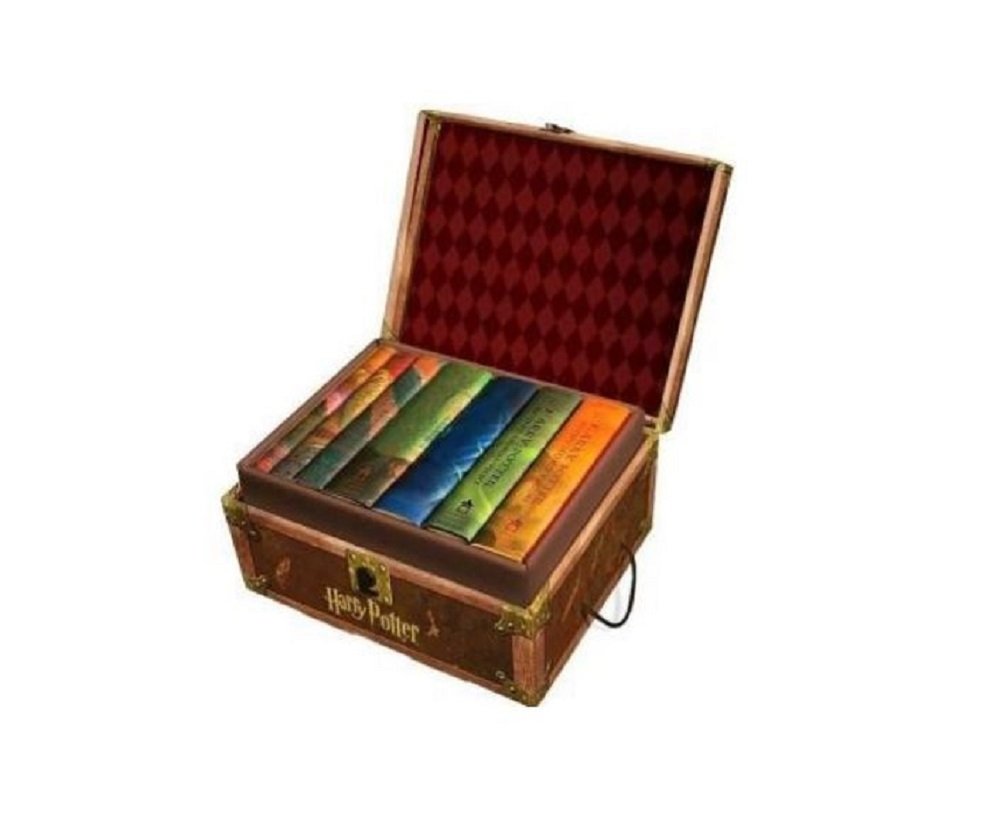
There’s a Harry Potter hardback box set that comes in a special chest and sells not as a route to cheap and quick, but as a route to one-off and exquisite. A technology that publishers have avoided and frowned upon is one that they could instead use to cater to that overlap in our Venn Diagram.
for around $130. This doesn’t seem unreasonable at all to fans of the series. For some of my readers, hundreds of dollars for a first edition of WOOL seems reasonable to them, even though the ebook is free. This got me thinking about print-on-demand technology 
Print-on-Demand (POD) means unlimited or zero copies, and both ends of this spectrum are important. Unlimited means never running out as demand goes up. Zero means not wasting a penny if there is no demand at all. POD is an end to guessing what readers want and constantly getting those guesses wrong.
Check out this Print-on-Demand book:
That’s a copy of MACHINE LEARNING, a complete collection of my short stories. It will be released on October 3rd by Houghton Mifflin Harcourt in hardback, paperback, and ebook. It was edited by John Joseph Adams, who also came up with the idea of publishing it. Before now, my short fiction has been scattered to the wind, published in so many places that I doubt anyone other than my mom has read them all. Some of these stories used to exist only on my old website; they became unavailable when I redesigned my homepage. Two of the included stories are brand new for this collection.
In addition to the stories, I wrote new thoughts about what each story means to me, or what I was thinking about or going through when I wrote them. These tidbits follow each story, and I think they add something to the reading experience. For those who are familiar with my work, you know how much the short fiction medium means to me. My success as a writer has mostly come through my short stories. I doubt any novel over my career will ever be as meaningful to me as this collection.
Which is why, when I needed to print out a proof copy of the manuscript to look over the final draft for changes and typos, I decided to do something a little different. Instead of going to Kinko’s and binding this as cheaply as possible (my normal practice), this time I went all-out. I tried to marry my love of the contents with an exterior to match. And here’s what I learned from this project:
I learned that I would have paid a week’s wage for a book like this, if it was the right book. As a bookseller, I used to make $10 an hour, and I worked thirty hours a week. Yeah, I was poor. But I spent what money I had on books, and I would’ve paid an entire week’s wage for a copy of ENDER’S GAME that looked like this – a one-of-a-kind hand-bound leather edition of my favorite read, signed by the author if possible. And I would’ve treasured that book for life and passed it down to a loved one. I’m one of those book freaks. I don’t think I’m alone. And I think it would cost precisely zero dollars for publishers to target this demographic using print-on-demand technology and by employing the fine folks who are keeping the art of bookbinding alive.
Here’s how I would make it work: I would convince a publisher (or a number of them) to enroll a ton of books into this program. I would especially go after the books that have sold millions of copies and have meant so much to so many readers. But really, just make every book available. It costs nothing, and millions of books are someone’s absolute favorite of all time. I bet every self-published author would add their works to the mix, and I bet Amazon would include their imprints as well.
The next thing you do is sign up a handful of book binders and crafters to meet whatever demand arises. I think you could get the cost of these books down if the people making them had steady sales. The crafter I used was Lindsey of BooksForAllTime. Lindsey is a true artist, and working with her was an absolute joy. I got to pick out the leather, the type of paper, the design on the cover, the gold leaf inlay, all of it.
So the program would work like it does with BooksForAllTime: You pick out your favorite book, customize it to your delight, and it shows up on your doorstep a month or two later. Slow. Expensive. The opposite of ebooks. But tapping into the same market of avid readers. That overlap in our diagram.
You might only own a dozen of these sorts of books in a lifetime. Or perhaps just one. Maybe you make a wishlist of your favorite books and make that list public for friends and family, so they know what to get you for Christmas or your birthday. Perhaps you have book clubs and programs that send you books on your wishlist every three months. Whatever you can afford. Maybe authors order one of each of their releases to have a library of their own books on display in their homes.
These books might cost $200 to $400 bucks apiece. Crazy? Then you aren’t part of the crowd I’m thinking of. I’m thinking of the crowd that collects these slowly, saving up, to see a row of Harry Potter books on a shelf that look like they came from Hogwarts itself. A Tolkien trilogy that even an orc could love. A Foundation Saga that could last from one foundation to another. The ultimate copy of Dune, Cosmos, or To Kill a Mockingbird. Eventually, after decades of a reading and collecting life, a small bookshelf of absolute treasures emerges. If you’re smiling at this imagery, then you are the crowd I’m thinking of.
But here’s where it gets very interesting: What if the author agrees to take a very small slice of that sale, a slice that would still be double the amount they make for a hardback (say, $3.00). And what if the publisher agrees to take the same measly cut (this would be a first). And what if the retailer did the same?
In other words: What if the book binder kept most of the profit?
Why would this make sense? Because I think there would be enough demand for these books to employ a good number of book binders like Lindsey. I think keeping the price of these books as reasonable as possible would expand the number of people who fit into the middle of the Venn Diagram. These exquisite books will expand the love of reading, the fetish for books and stories, and they’ll last for ages.
The ridiculous and ultimate fantasy is that we parlay the untapped money in the pockets of book lovers worldwide, and we move that money into the pockets of people whose jobs are being displaced or upended by changes elsewhere in the global economy. Books being bound in developing countries. Books being bound by former coal miners. Would global demand for bespoke books be enough to move a million leatherbound titles a year? If so, that’s a living wage for thousands of people. Much more if you’re talking about developing countries.
This might sound crazy, but community bookstores are made possible in part by the willingness of some readers and gift shoppers to pay extra for something they love. The reason books make such great gifts is that we feel like we’re buying something that is good for the recipient, as well as bringing them joy. Parents of book-loving kids know what this feels like: it’s like having kids who beg for their veggies.
Imagine buying a loved one a book they’ll cherish forever, and knowing that the person making the book is having their life changed as well. Imagine spreading the joy of reading and the joy of books by using a technology that removes the risk from publishing, that allows us to create something not cheap and expendable, but rather exquisite and irreplaceable.
When I’m done with this book, I’m going to do what we often do with physical I’m going to pass it on. It’ll be a gift to someone who has furthered my writing career. If you want your own copy of MACHINE LEARNING, you’ll have to settle for the regular hardback, paperback, or ebook, which you can pre-order here. Or if you’re interested in something leather-bound and special, I own the print rights to lots of my works. Maybe Lindsey could make you a special edition of MOLLY FYDE AND THE PARSONA RESCUE or HALF WAY HOME. Or perhaps other indies will open their works, and other bookbinders will get in on the fun.
books: 
This won’t be for everyone. Just the nuts in the middle.
So what would your favorite book be worth to you?
Howey has written an interesting piece here, and a lot of it I wholeheartedly agree with and find hopeful. However, I do think Howey is being a bit too idealistic when it comes to some things, particularly the cost of publishers creating POD books. The truth of the matter is, every book and every step of said book's sale, has overhead. It isn't free for publishers to do this sort of thing. So many people have the same view as Howey when it comes to things like POD and e-books because they think that once the book is written and formatted, there aren't anymore costs. Even turning an e-book into a POD requires more work and cost.

I do wish it could be as easy as he says, though, and that more people who can afford it would be willing to pay extra so that people who can't can pay less. But honestly, I don't think that's going to happen. People who can afford it may buy more expensive editions of books, but that doesn't affect people who need to buy less expensive editions. It doesn't work like a subsidy does, and publishers aren't going to have an expensive and a cheap edition for each book. And if they did, people are going to pick the cheap one, often even people who can afford the expensive one. So then we'll be right back where we are now, and publishers will continue to price books the way they need to in order to cover their overhead, advances, and make a profit. Because publishing is, after all, a business, even if it's one that has art at its core.

Wednesday, July 3, 2013

Self-Publishing Strategy: HAVE ONE.

As the self-publishing world grows and grows there is more and more research to be done before taking the leap. What self-pub platform to use, what retailers to target, if you should use a distributor, print and eBook or eBook-only--the list of non-editorial decisions is longer than I am tall. Then there are the editorial ones--the cover, the blurb, the content itself. So. Many. THINGS.

While some self-published authors are doing fabulously, though, a lot of them don't get the reception they were hoping for in this crazy market. Kristen Lamb over at Warrior Writers today took a look at some of the reasons why in her post "Freedom isn’t Free—5 Common Tactical Errors in Self-Publishing." Her thoughts are insightful (and true, if you ask me) and can help any author thinking about self-publishing determine if they are prepared, even with just the basics:

[...] 
Tactical Error #1 Publishing Too Soon
The problem with the ease of self-publishing is that it is, well, too easy. When we are new, frankly, most of us are too dumb to know what we don’t know. Just because we made As in English, does not automatically qualify us to write a work spanning 60-100,000 words.
Too many new writers do not properly understand the antagonist. They don’t grasp three-act structure, and most don’t have any idea what I mean when I mention POV, Jungian archetypes, or the phrase, “scene and sequel.” 
[...] I see a lot of new writers who believe their story is the exception, that the rules make for “formulaic” writing. No, rules are there for a reason, and, if the writing is too formulaic, it has more to do with execution than the rules. 
Three-act structure has been around since Aristotle, and there is a lot of evidence in neuroscience that suggests that three-act structure is actually hard-wired into the human brain. Thus, when we deviate too far from three-act structure, it confuses and frustrates readers. 
Stories have clear beginnings, middles and ends. 
Yes, we are artists, but we need to understand the fundamentals. I played clarinet for years, and yes it was an art. But this didn’t excuse me from having to learn to read music, the finger positions and proper embouchure (the way to position the mouth to play). 
The better we are at the basics, the better we know the rules, the more we become true artists. 
I’ve received contest winners whose first pages were filled with newbie errors. Yet, when I sent them my critique filled with pages of corrections, I would then receive a reply telling me that the book had already been self-published. 
OUCH. 
Sometimes there are reasons we are being rejected and we need to take a hard look and be honest. Self-publishing is suffering a stigma from too many writers publishing before they’re ready. If you really want to self-publish, I’m here to support you and cheer you all the way, but remember, we have to write better than the traditional authors. 
Tactical Error #2 No Prepared Platform 
The day we decide to do this writing thing for real is the day we need to start creating a platform and brand. Even traditional authors goof this up. I cannot count how many times I get a message saying, “Hey, I have a book coming out next month. I need to do social media. Can you help?” 
Seriously? O_o 
I’m Kristen Lamb, not Harry Potter. 
Tactical Error #3 Believing that, “If We Write it They Will Come” 
There are a lot of writers who mistakenly believe that self-publishing is an easier and faster way to fame and success. Yeah, um no. And those magic beans are really just beans. 
Sorry. I was bummed, too. 
Self-publishing is A LOT of work, especially if we are starting out this way. I know Bob Mayer and Joe Konrath lecture writers to do less social media and more writing. To an extent I agree, but here is the thing. These guys were branded traditional authors who could slap New York Times Best-Selling in front of their names when they decided to go it alone. 
If you can’t slap New York Times Best-Selling in front of your name and upload a NY vetted backlist longer than your arm? Prepare for a ton of work. 
Tactical Error #4 Misusing FREE! 
There are a lot of problems with giving books away for FREE! We shouldn’t be giving away our work unless it serves some kind of a strategic advantage. There are ways to effectively harness they power of FREE! but too few writers understand how to do this and they just end up giving away their art for no tangible gain. 
Tactical Error #5 Shopping One Book to DEATH 
One of the BIGGEST problems I see with self-published writers is that they publish one book and then they focus every bit of energy on selling THAT book. 
They fill up #MyWANA and all the writing hashtags with link spam promoting their books. They keep futzing with the cover, the web site, the promotions. They do blog tours until they drop, and they do everything except what is going to help that book sell a ton of copies…write more books. 
Here’s the thing. Self-publishing, in many ways, just allows us to accelerate the career path of the author. Even in traditional publishing, it usually takes about three books to gain traction. In traditional publishing, this takes three years because we are dealing with a publisher’s schedule. 
In self-publishing, we can make our own schedule, but it still takes THREE BOOKS MINIMUM. I know there are exceptions, but most self-published successes hit at about book three. The ability to offer multiple titles is a huge part of why John Locke became successful. 
This is why it is critical to keep writing. Not only will writing more books make you a better writer, but once people discover they love your writing, they have a number of titles to purchase. Being able to offer multiple titles is how we make money at self-publishing. It also helps us maximize the whole FREE! tactic. 
Yesterday, I bought six books (1,500 pages) of research. I just published my latest book five days ago…and I’m starting on my next book. Goal is to have the first draft completed by August. I don’t tell you guys to do anything that, I myself, am unwilling to do. 
Remember Why We Do This 
Self-publishing is a wonderful alternative. Just because we self-publish doesn’t mean we cannot publish other ways, too. I feel the author of the future will actually be a hybrid author, and I do believe that the ability to self-publish is challenging all of us to come up higher. We are striving to be better writers, to be better entrepreneurs, to get better at organization and time-management and to write more books and better books. If we can learn from these mistakes and grow, then the future is ours for the taking. 
See the complete original post HERE


Kristen's site is a great place for writers to get some handy tips (and a good laugh--she's a funny one!), so be sure to check it out. Her newest book, Rise of the Machines--Human Authors in a Digital World, is on sale for $7.04 at the moment to celebrate Independence Day.

Friday, March 29, 2013

Goodreads: An Amazon Acquisition

After working in the publishing industry for so many years, I've learned that there's sadly a good bit of passive aggression going on behind the scenes--as it does in every industry, really. But sometimes, publishing's particular brand of rivalry is more public than most.

Like today's announcement that Amazon has purchased Goodreads, for example.

Forbes.com tells us more:

After two years of stops and starts, Bookish, the book discovery and e-commerce website co-owned by three of the world’s biggest publishers, finally opened for business in February. Seven weeks later, Amazon has acquired Goodreads, the leading book-centric social network. 
Coincidence? 
Of course, with 16 million members, San Francisco-based Goodreads is a logical enough acquisition target for the e-tailer. (The sale price hasn’t been disclosed but seems likely to have been in the low eight digits; according to Crunchbase, Goodreads had raised a total of $2.75 million in funding.) 
The two sites aren’t mirror images of each other. In particular, as Laura Hazard Owen explains, Amazon and Goodreads make recommendations based on something called “collaborative filtering,” which factors in a user’s past activity and the behavior of similar users. Lacking Amazon’s servers full of data, Bookish — which is backed by Penguin, Hachette and Simon & Schuster — bases its recommendations more on content analysis. Bookish also lacks Goodreads’ social layer. 
Still, the similarities are sufficient that when Bookish launched in February, a Wired writer dubbed it “the love child of Goodreads and Amazon.” 
One thing to keep an eye on is whether an Amazon-owned Goodreads will continue to drive customers to other retailers. In 2011, the site stopped using Amazon’s API, saying the terms of use were too restrictive – in particular the requirement that all product links go to Amazon rather than to other retailers. 
In a blog post announcing the sale, Goodreads founder Otis Chandler suggested nothing is going to change, at least immediately: “Amazon supports us continuing to grow our vision as an independent entity, under the Goodreads brand and with our unique culture.” 
Obviously, Amazon would rather not send potential book buyers to its competitors. But with a new anti-trust lawsuit accusing it (and the six biggest publishers) of wielding too much control over the e-book market, this isn’t the time to be seen as acting like a monopoly. 
See the original post HERE


Oh, publishing...what will you come up with next?

Wednesday, March 27, 2013

A Wednesday Full of Romance

So far this week, I have edited two books, read three submissions, and am about to dive into another edit today. All for romance novels. Which I found ironic given the lead article today on the Huffington Post's Books page: "Trash or Treasure: Why More Women Should Read Romance Novels."

In the post, author Sherryl Woods provides some of her personal insight into romance novels, why they are so popular, why they are significant:

A number of years ago at the height of the shirtless hero craze on romance book covers, one of my novels featured an artist's rendering of an impish little girl dragging angel wings. A television news anchor in Washington, DC, held it up on camera and asked, "Where's Fabio?" 
I laughed and told him, "Fabio doesn't live in my books." 
While it's pretty clear with well over 100 novels to my credit that I'm a huge fan of romance, my infatuation with the genre goes beyond Fabio and other sexy cover models with their six-pack abs and larger-than-life persona. As a reader and as a writer, I want the kind of hero who might well live down the block and walk into my life at any second, the guy with a sense of humor, with strong values and a degree of dependability that will make him a wonderful lifelong partner. 
I often hear from readers that what they love the most are the "real" people who live in the pages of my stories. They identify with the women who face problems that they themselves have faced. They're inspired when the characters not only survive, but thrive. In fact, for some the characters become so real, they tell me they worry about them between books. And just recently I heard from a man who said the stories had helped him to rekindle the romance in his marriage after 22 years and 8 children! The simple fact that he was looking for ways to rekindle the romance made him a hero to my way of thinking. 
As far back as I can recall both proponents and critics of romance novels have labeled many of them as fantasies for women. Critics suggest that creates unrealistic expectations. Proponents cheer for the fantasies that keep female blood pumping and spawn a few steamy dreams. 
I tend to look at romance -- in books and in real life -- a bit differently. While the arrival of a knight-in-shining-armor in the middle of a crisis might be a welcome sight and being carried off to a carefree life of wealth and pleasure might even be a secret dream, most of us are going to find romance in other ways. It's going to be in that sweet, unexpected comment that makes us smile or the little gesture that demonstrates just how much we're appreciated. Our hero is going to be the guy who notices that something needs fixing and just does it or who plans a special date that might mean nothing to another woman, but means the world to us. It may even be the man who stands by, ready to help in a crisis, but wise enough to know how much we need to discover we can depend on ourselves. 
I think our view of romance -- what we want and what we need -- changes over time. Age and experience kick in. While the very young want the heart-stopping excitement and passion, in time we come to appreciate a good laugh, respect, and common interests. 
The one thing that never fades is the longing to see "that" look in someone's eyes, the twinkle that makes us feel desirable and alive. I think that's one reason so many of my books are multi-generational, with people of all ages discovering that a new romance may be just around the corner. I believe in those possibilities that remind us life can be worth living till the very last breath we take. 
In my Sweet Magnolias series, for instance, there are several "senior" Magnolias, who openly talk about their views on finding love at their stage of life. One is actively dating a younger man to the horror of her suddenly traditional middle-age daughter. A few very lively debates ensue that I imagine many of us can relate to -- from one point of view or the other! 
In this latest Ocean Breeze trilogy, which kicks off March 26 with Sand Castle Bay, not only do the three Castle sisters find love, but so does their grandmother, Cora Jane. The issues she faces as a widow who was happily married for many years are very different from those who were unhappily wed. And for me there was something especially endearing about the patient man who stayed in the background, never even hinting at his feelings out of respect for her husband and her marriage. Now, though, he's courting her with all the understanding he's gained through years of friendship. 
Bottom line, whether we're in our twenties or our seventies, we all need a strong bond to another human being. In fact, for older women, who've been widowed or divorced or never married at all and who may have given up on love, unexpectedly finding romance may be the sweetest joy of all. 
And when we're feeling low, reading about romance in the pages of a good book, can be just the reminder we all need to get out there and keep trying. Love could very well be right around the corner, just down the block or even in the house next door! As Jane Seymour says in the commercial for her jewelry designs, the key is to keep our hearts open. 
See the original post HERE


After reading Sherryl's piece, I have to say I agree with her (though have additional opinions--naturally. It is me after all). Romance novels are not just silly fantasies. They are about believing in love and the power of the heart, which is truly the reason we're all here in the first place. Love. Of all shapes and sizes. Romantic, familial, platonic. Romance novels often touch upon them all. It's about the romance of life, not just silly fantasies. Plus, they often make you laugh, cry, and just feel. Something I think we all could use a little more of.

So, pick one up, give it a whirl. And if you need recommendations, you know you to come to... *points to self* this girl.

What is YOUR favorite romance novel? 

Friday, December 7, 2012

Spreading the Love

This week, the Big 6 have sure been busy. While Random House employees cheered as they received UNHEARD OF year-end bonuses for our industry, some folks over at Hachette Book Group made this moving video to honor the It Gets Better LGBT campaign.

This made me smile at the end of a long work week:


The 'It Gets Better' Project was founded in September 2010 by columnist and author Dan Savage and his husband Terry Miller, "to show young LGBT people the levels of happiness, potential, and positivity their lives will reach." Since then, more than 50,000 user-submitted videos have been made by individuals and companies, to share their heartfelt messages of experience, hope and tolerance.

Among the latest of these is the Hachette Book Group, one of the biggest publishing companies in the world.
Their video is posted above.

Excuse me, I think there's some dust in my eyes. *sniff*

See the original post HERE

Monday, November 5, 2012

Monday Afternoon Amusement...Starring Hitler

Just as I was starting to lose complete focus today, my boss shared this little gem with me regarding the Penguin Random House merger announced last week.

It is a bit insensitive, so if you are easily offended, pass this one by.

I, however, found it hilarious.


HITLER REACTS TO THE PENGUIN RANDOM HOUSE MERGER


Wednesday, August 29, 2012

Two New Indy Bookstores in Astoria, NY Neighborhood

Just about nine months after the news that Astoria's only independent bookstore was closing, there is now word of TWO new bookshops in the hood: one specifically for kid-lit--and already open--and one coming soon for more mainstream adult titles.

According to the Daily News, The Story Nook opened this past February to offer children's literature to local kiddies. While I'm very excited that this occurred, it's surprising that this is the first I've heard of it. Sounds like The Story Nook needs some publicity help---so GO TO THE STORY NOOK.

Now that that's been dealt with, here's more from the Daily News on the upcoming Book Shop:

The borough’s only independent bookstore that sells mainstream titles is slated to open in Astoria early next year, much to the delight of local book lovers.

Despite a tough economy and a bruising market for book sellers, Lexi Beach said she plans to go ahead with plans for the Astoria Bookshop.

Beach, 31, who manages accounts for a website that sells digital audio books, is already arranging author events in the community to build awareness — and anticipation — for the shop.

“I’m confident that a good portion of the community will be very excited about having a place to buy books locally,” said Beach, who is raising funds for the shop.

“Obviously, anyone with a computer or smartphone can buy books online,” said Beach, who plans to host community events in the space. “But there’s something about a bookstore, a physical place to go and browse books, that is special.”

She began mulling the venture after hearing from friends of the need in the neighborhood following the closing of Seaburn Bookstore in December.

The longtime Astoria store hadn’t turned a profit in years, owner Sam Chekwas previously told the Daily News. A much smaller version of the shop was relocated to a Long Island City warehouse where he has a book publishing business.

Tim Fredrick, editor of the Newtown Literary, a journal that will feature the words of borough authors, said Beach’s store will be a boon to local authors.

Beach “is very interested in promoting Queens authors and Queens writing,” he said. “It’s really a shame to have to go to another borough to buy books.”

Mackenzi Farquer, owner of SITE NYC, an Astoria boutique, said most of the 100 participants of a survey she recently conducted said they wanted to see a bookstore in the neighborhood.

“Astoria’s rapidly gentrifying,” she said. “There’s this pocket of Astorians who really want bookstores.”
The community may soon also have a children’s bookstore.

Faye Skandalakis opened The Story Nook in February in a small section of babyNOIR, a kids boutique, on 23rd Ave.

“I’m hoping within a year or so to open a brick and mortar children’s bookstore,” she said.

Oren Teicher, CEO of the American Booksellers Association, said he’s starting to see “modest growth” in the number of bookstores nationally “after many years of decline.”

The demand is a product of the closure of the chain book retailer Borders, consumers desire to shop locally and lower technology costs, he said.

But small bookstores still face a host of challenges — including the rise of e-book readers and online retailers, such as amazon.com, that can offer rock-bottom prices.

“Being able to compete in a market where anyone can sit at their computer screen and have access to any title in print, that certainly represents a challenge,” Teicher said.

See the original post HERE
 

I'm excited to hear about these new shops and my fingers are crossed that they are able to survive the brutal market that has flooded the publishing world. I too have considered opening my bookstore again--a dream of mine since I was a kid--but the market scares me away. But I guess it's true that it's all about location, location, location. And if Astorians want their bookstores, give 'em some!

I, for one, can't wait. Thanks for being brave Lexi and Faye!

Monday, July 16, 2012

A Lesson in Life...and Publishing

Not always what they seem to be...
I was emailing last night with a new friend of mine in Alaska and telling him a bit about New York City. I told him stories of subway antics, dating woes, the works, and it reminded me that even people you think you know are not always what they seem. This is, of course, something I know very well--we all do--but a little remembering can't hurt when you're out there in the wild, wild world.

Given that, the article I read this morning on HuffingtonPost.com was very fitting. A story of a new author whose first agent turned out to be more than just a "hack":

Some people say life imitates art. Other people say art imitates life.
Here's a true story that clearly supports the "life imitates art" argument, and when it does, life can turn out stranger than the art it set out to imitate in the first place.
It goes like this: At the turn of the century I wrote the first draft of Hack, a novel which, after 12 years and several close calls has just been published by Harper Davis Publishers. In it, the protagonist fakes his own death and returns under a new identity to bilk fat sums of dough from greedy rich guys.
Hold that thought.
I signed on with my first literary agent, Melanie Mills of North Myrtle Beach, SC, on August 26 2002.
Dear Mr. Harrison: 
I have reviewed your work titled "Hack" and have reached a positive evaluation of the property. I feel this property could have a great market appeal and if you choose I would like to market this book for you.
A "positive evaluation of the property"? Hallelujah!
I worked on the manuscript through the winter and in the spring we submitted and got four "good" rejections. Melanie was encouraged: all four editors agreed Hack was a riveting story with quirky characters, but the premise was too far fetched to be believable.
Then it was Spring Break, and by chance I found an almost-free timeshare in Myrtle Beach, which in April promised family fun and a face-to-face meeting with my agent.
And so I went to meet Melanie Mills. Beyond the paved roads and onto rutted single tracks snaking between shacks on stilts crammed together, I found her: a tiny elf-like being, hunched over the deck railing of her falling-down shack. She was scraping at some old paint, a cig dangling from her lips, and a blonde wig, teased and blown into a platinum rat's nest, resting atop her pointy little head.
We sat on her deck overlooking the slough. She talked while I noticed that it smelled more like the county dump than the salty seashore. She showed me the handful of rejection letters as she pounded back Dr. Peppers, puffed on pack after pack of Dorals, and drawled like John Wayne on Dilaudid.
She even explained that her great legs (she stood up to show me) were due to six-miles-a-day beach walks. She also mentioned that she was hosting a writers' conference during a Harley rally in Myrtle Beach the following month, and another in the fall in Banff Lake Louise.
At her suggestion, when I got back to Fairfield County I made some broad brush changes to the manuscript, such as making the female protagonist "less of a bitch" (Melanie's words) and sent it back to her. Her assistant, Kat Baker told me that Melanie was traveling in Germany. I waited three weeks, and when I didn't hear from her, I contacted her office again. I received this email in reply:
Last week, during her trip to Europe due to a death in the family, Melanie Mills had a fatal car accident. Therefore, all submission to publishers have been retracted, all events cancelled, and all existing publishing contracts have been reverted over to the individual authors. I'm very sorry. This has been, and still is, a very emotional time for her entire family and friends, 
Good luck to all of you,
Kat Baker
Assistant to Melanie Mills
Never mind that she looked like Dobby with a fright wig and sounded like The Duke, I had sipped 7Up at her table in Myrtle Beach. We shared laughs. And we had talked about Hack, my story of faked death and identity fraud.
So, when I heard this news, I felt as if someone had kicked me in the crotch. I couldn't breath; I lost the feeling in my hands. And I bemoaned my bad luck. Now what was I going to do? My literary agent was dead!
I began scouting for a new agent. I didn't think it would be too hard -- "Hey, my agent died, would you mind reading a few chapters of the novel she was representing?"
I was right. I had many tire kickers right away, and by the following spring a new agent with a whole notebook full of new ideas for Hack. But somewhere along the line, someone suggested I look at the website "Writer Beware". And it was here that I discovered what really happened to Melanie Mills.
She didn't die in a car wreck in Germany. Not only did I learn that my former agent was still quite alive, but that she had roughly 15 aliases and that she was wanted for real estate fraud across the southern part of the United States, including, of course, Myrtle Beach.
She was also wanted for the attempted murder of her own mother who she pinned to a cement table with her car, crushing her pelvis.
Oddly enough, she had also published "a mystery novel under the pseudonym L.R. Thomas.
Her pitch letter to publishers began: "What would you do when your mother, who leads you to believe she had died, shows up months later and tries to kill you?"
Melanie Mills obviously had a thing for resurrection.
So how did she finally get caught? As it turns out, before she "died" she did organize that writers' conference in Banff Lake Louise, that she'd mentioned when I met with her. Ironically, she did not encourage me to register, supposedly because I already had an agent (her).
The conference advertised big name authors, publishers, and agents, all drooling to make a six-figure deal. She organized and published the schedule on a dedicated website, advertised on all the sites where unpublished writers troll for agents, deployed a reservation system and started collecting money.
After defrauding writers of the fees for the conference, she took off for Germany and was killed, unrecognizably mangled in a bloody wreck. Of course the planned conference attendees, upset though they were by her death, wanted their money back. But when the authorities went looking, they found not a trace -- no bank accounts, no real estate, nothing to indicate that she had ever existed.
And in Arkansas and Myrtle Beach, where she was wanted for real estate fraud and attempted murder, more authorities started to follow the her trail. With the help of Writer Beware, they made the connection between various aliases and found her. Last I heard, she has yet to be extradited to Arkansas to face attempted murder and fraud charges, and a judge had declared her unfit for trial: She'd shed her orange jumpsuit in the courtroom and was commando underneath, leading to a diagnosis of acute schizophrenia. I suppose she won't be doing any Martha Stewart-style hard time soon.
So we've got life imitating art all over the place here, and yet, Melanie Mills never charged me a nickel for her services. Usually literary agent con artists charge a reading fee, an editing fee, a submission fee and then they don't shop your book. I guess Melanie Mills was ever the anomaly, or perhaps playing legit with me was her way of thanking me for giving her the idea for her biggest con.
I will probably go to my grave wondering if Hack's fake death, and his return as a swingin', Harley-ridin', Mexican with a ponytail and pencil-thin mustache, along with his plan to rip off as many people as possible, got Melanie Mills thinking -- maybe such a plot isn't so far-fetched after all? I guess she found out.

Read the original post HERE

Eyes open, friends. Do your homework. Be careful and look out for yourself in all areas of your life!

Wednesday, March 28, 2012

A Little Personal News on This Wednesday Afternoon

Hi, all. So, I made an announcement today over at the Book Country blog that I wanted to share with you. I've been keeping it under wraps for a while for a variety of reasons but on April 6th I'll be stepping down as Book Country's editorial coordinator and moving into a new position on the 9th as the QA Specialist for Penguin's tech team.

It's a big change for me (and we all know how well I deal with that haha) but I think it will be a good one. Give me more structure, shift my life a bit so I can spend more energy on my own writing and freelance work, etc. And it's always fun to learn something new and be a part of exciting new projects. I won't lie though--it is very hard for me to step away from the community I so love and believe in. There are such wonderful people and promising writers that make up Book Country. I plan to stay a part of it as much as I can though, participating on my own as a writer and editor as well as continuing as an official moderator.

Anyway, take a look at the post and you will also meet the new Book Country assistant, Nevena Georgieva, who is totally amazing and will be a great member of the team!

Friday, March 23, 2012

Guest Blogger, Gloria Loman: Little Things...Like Knowing Your AUDIENCE

Why, hello again, Booklanders!

It’s time for us to chat about something a bit more serious—and infuriating—about the state of the book biz these days.
Earlier this week, B&N announced who the typical Nook customers are: women a little afraid about technology who value content. They nicknamed her “Julie.”
Well, well. Isn’t that nice? Publishing seems to have finally caught up with most other commercial businesses in knowing their customer!!!
A few years ago, I had a savvy entrepreneurial author ask me if the publisher I worked for planned to test her title or cover through focus groups. I laughed, even though I thought it was a great idea. The truth is that all the important decisions made on any book—covers, titles, subtitles, even what gets acquired—are made by publishers, editors, publicists, and marketing managers. These people may not have read the manuscript in question, may not read the genre or category, and may not even have set foot in a bookstore for the past six months. Frankly, I feel that most of my colleagues in publishing have no idea what the average reader is looking to read or how they browse a bookstore.
There are many problems ahead for legacy publishing (Amazon, fewer bookstores to sell more books at, the availability of self-publishing options, e-book pricing) but for me, the elephant in the room is not knowing who our customers—readers—are, and what they are willing to spend $27, $15, $9.99, or $1.49 on.
Consider this: do any of the Big Five publishers (Simon & Schuster, Random House, Harper Collins, Hachette or Penguin) really know who their customers are? No. Should they? Yes.
The best example of how this works successfully is in retail—Bloomingdales’ staff knows the general profile of their customer (suburban/urban, affluent, elegant) as does Wal-Mart (suburban/rural, price conscious, conservative). But smart suppliers know their customer too, even in creative industries. Donna Karan knows who buys DKNY and who buys her couture; why can’t publishers know exactly who we are publishing books for?
Some of the problem lies in publishing folk having the wrong idea about who buys our product. We like to pretend that everyone reads as voraciously as we do and that each individual believes that books are as necessary to life as air, but neither is true. We should be able to target specific audiences, from the lady who is in four book clubs (our most devoted and regular customer base) to the college kid who buys the huge bestseller only after it’s made into a movie (the occasional customer). We need to know why people buy our books in order to give them what they want.
Thanks to technology (which “Julie,” apparently, is scared of), we can easily and cheaply find out. Once again, retail shows us the way. We could work with different sales channels to reward repeat customers. Buy three Vintage books, get one free by redeeming it through Random House’s website, no matter where you buy the other three titles. Continue to offer $1.99 e-book specials each month, but require that readers sign up for the HarperCollins email newsletter (which not only promotes future titles, but also registers a customer’s preferences upon subscription). Imprints at S&S and Penguin could offer a free book if customers take a survey about their reading habits on Twitter. Publishers could even require retailers to tell us what they know about customers (gasp!). All of these techniques could help publishers sell more books, from being able to make better acquisition decisions to improving publicity and marketing campaigns. Retail figured this out long ago: knowing your customer is the key to getting and keeping that customer—and essentially to making more money.
Publishing people rely on each other as “taste-makers,” to intuit the audience for a book—guesstimating at its best. However, most people at the Big Five rarely act like everyday readers: They don’t read their favorite authors anymore (because they’re too busy reading for work); they browse bookstores looking for specific books instead of seeing what catches their attention; and worst of all, when they talk about a popular book, they discuss publishing strategies rather than its plot, characters, or why they enjoyed it (or not).
Hello, publishing people? If we want to save this industry, we need to become readers again. Maybe all you Booklanders can even help publishing folk get back to the true reason we’re all in this business.
Let’s encourage each other to read one book a month that’s not for work, simply something you would have picked up on your own before you read constantly for your job.
Let’s encourage the savvy publishers we work for to use a simple technique that has been successful for so many other businesses: Know your customer and produce product that they love.
If we get to know “Julie” and successfully entertain her, then we will continue to thrive and be relevant. But if we maintain a distance between ourselves and our readers, we are likely to not only fail “Julie” but the readers we all are too.

Wednesday, March 21, 2012

A "Wacky Wednesday" Indeed

Man, I loved that book, Wacky Wednesday. It was so random and weird and, well, wacky. I guess I shouldn't be so surprised though, given most of Dr. Seuss's books are a little off the deep end. AWESOME. But certainly odd.

I was reminded of this book today when my friend Allison sent me a link to this recent GalleyCat post:

Someone mailed more than eleven pounds of marijuana to Macmillan’s St. Martin’s Press offices. The Smoking Gun broke the story today.

Bound for a fictitious employee named Karen Wright, the shipments had a potential street value of $70,000. We performed a few Google Books searches, but couldn’t find any clever literary allusions hidden in the fake employee’s name. Now everybody wants to know–who is Karen Wright?

Check it out: “The pot parcels, mailed from San Diego, never made it out of California, however. A post office employee contacted postal inspectors after alerting to the distinctive scent of the two packages. According to mailing labels, the boxes were purportedly sent by ‘ABT Books,’ a San Diego firm that listed a return address that investigators determined to be fictitious.”

See the original post HERE


Ahhh, just another Wednesday in publishing.

Wednesday, July 27, 2011

Bye, Bye Borders :(

So, while I've been out of commission, it seems that the news that Borders was being bought is sadly outdated.

Borders has officially announced that they are closing their doors. Stores are having "Everything must go" sales and Borders bucks are drying up.

It's upsetting to most of us for sure. But it also leaves a very controversial question unanswered: What happens next?

The Atlantic posted an interesting piece about the matter this morning:
Manhattan's West Side might have more book readers than anywhere else in the United States. Until recently, the thriving cultural stretch of Broadway that includes the theater district, Lincoln Center, and some of the city's best venues for quality movies was also choc-a-block with enormous bookstores. The high-rise Barnes & Noble emporium opposite Lincoln Center closed several months ago because of soaring rents, and now the expansive and elegant Borders superstore in the Time-Warner Center on Columbus Circle is on the way out, as the chain goes into liquidation.

So, in this flourishing area of the city -- a span of more than three miles -- there is no longer a general interest bookstore. There are still many good places to browse the aisles for books elsewhere on the island -- The Strand, Posman's in Grand Central Station, and Book Culture in the Columbia University neighborhood, among others. Barnes & Noble is still going strong -- its superstores in strategic locations are bustling, B&N.com has been gaining traction, and the Nook is clearly the runner-up to Amazon's Kindle as an e-reader favorite. Nonetheless, the demise of Borders signifies a major change in the marketplace for books. The unraveling of the country's second largest book chain means a tremendous boost for digital retailers such as Amazon and the potential for a self-confident Barnes & Noble and the stronger independent stores to benefit by adding customers.

But there is no doubt -- as I have written many times in recent months -- that the book business is in a period of change so dynamic that any outcome is possible, from an era of exciting expansion to a precipitous decline in sales at brick-and-mortar stores that undermines the revenue base of publishing. A year ago it would have seemed inconceivable that Broadway's biggest bookstores would be shuttered.

In fact, until last weekend, I couldn't really fathom that Borders, for all of its mismanagement and losses, would not find a way to continue, in the jargon of bankruptcy, as a "going concern." But once the last stores are closed in September, all that will remain of this once proud and sophisticated bookseller will be remnants: the brand name (for sale), the memberships in its customer loyalty program, a struggling website, and a minority interest in the Kobo reading device. Books-A-Million, a regional chain in the south and midwest, offered to take over the leases and contents of up to thirty-five venues across the country, from among Borders remaining 399 stores (at its peak Borders had almost 1,200 stores). But that deal fell through.

It would be wrong to assume that the demise of Borders is symbolic of publishing Armageddon. And yet, the disappearance of Borders and the uncertainties that Barnes & Noble doubtless faces as it is accommodates the pace of change to digital reading are extraordinary developments. In the first five months of 2011, e-readers sales are up by 160 percent over the previous year, but there has been a sharp drop in revenue from printed books, attributable in large part to the Borders collapse.

For the moment, even some of Borders' competitors are delivering eulogies. Rachel Weaver and Jason Smith at the Book Table in Oak Park, Illinois, told Publishers Weekly:

It's a sad day for reading when there are fewer communities with bookstores, a place where someone might stumble upon a book to read who otherwise might have gone home to their television or their Internet connection for entertainment and companionship. Frankly, speaking as two people who have each worked in the industry for close to two decades, it is just plain devastating.

PaidContent.org, one of the best media business blogs, took an especially gloomy view of Borders' downfall. In a FAQ feature, Laura Hazard Owen concluded that liquidation is "unequivocally bad news for publishers and authors. Bottom line: The closure of Borders means fewer places to sell books (and promote books and book discovery). Publishers will have to reduce their print runs and shipments." By contrast, Oren Teicher, the CEO of the independents trade group, the American Booksellers Association, commiserated with the thousands of Borders employees losing their jobs but added, "We do not believe that the Borders closing is a bellwether for the future of brick-and-mortar bookstores nationwide. Rather, it is, in part an unfortunate right-sizing of bookstore landscape that has suffered from expansion in certain markets . . . we see opportunities for our current members to expand and for new stores to open."

Who is right? The answer is that no one really knows. But I especially liked the observation of Neil Strandberg, manager of operations at Denver's great independent, Tattered Cover. On PBS's Art Beat, he commented:

The work of Tattered Cover has been, then, to re-shape the business out of acknowledgment that printed book sales will continue to decline for the foreseeable future. We are smaller, retail-space wise than we were a few years ago and we will be smaller, I wager, a few years hence. Meanwhile we experiment with new product, inclusive of ebooks via our partnership with Google, food, gifts and services to local authors. I have every reason to believe that in ten years' time, there will be a retail setting that everyone recognizes as the logical descendent of today's retail bookstores. The trick for all of us is to juggle declining printed book sales with new products and new services and the appropriate amount of real estate in the right location. . . . Taking a cue from some of the technologies that have been so disruptive, collectively, the indie community is crowd-sourcing the sustainable bookstore-like thing of tomorrow. One of us is going to figure this out.

Ultimately, I believe Borders' downfall had more to do with its own strategic mistakes than what is happening in the broader landscape of publishing. But I do share the sense of those who will miss Borders, not the flailing failure it was at its end but the great contribution it made to the availability of books of all kinds to so many people when it was at its best.

Borders RIP.

See the original post HERE

Thursday, January 20, 2011

B&N Lays Off 40+ Book Buyers and More

It's no surprise that in this extremely volatile market, major publishing and bookselling corporations have been struggling. Indies closing, Borders unable to pay its bills, houses reorganizing imprints and laying off employees, etc. The one book biz staple we hadn't heard much from was Barnes and Noble.

Until yesterday, that is, when the news that Barnes & Noble was "restructuring" their office environment by laying off more than 100 staffers spread like wildfire yesterday.

Readers and industry insiders alike are up-in-arms about this new development, not only because of the firings themselves but also because of B&N's cavalier attitude toward the matter.

Here's the skinny from Publishers Weekly:
Barnes & Noble has confirmed what it is calling “a small number of organizational changes this week” that the retailer said were “designed to better align our resources with our business.” The changes appear to be mostly in the buying group. B&N wouldn’t confirm the number or names of people let go, but PW has learned that Bob Wietrak, the well-known v-p of merchandising, and Marcella Smith, director of small press and vendor relations, have left the along with a number of buyers, including cookbook buyer Lee Stern. Reports say about 45 to 50 positions in the buying group were eliminated.

A B&N spokesperson stressed that the company is reallocating resources to areas that are expanding, such as its digital operations, but had no comment on how duties of the departed buyers and others would be divided up. Publishers were shook by the news with the larger publishers wondering who would oversee merchandising, while smaller presses questioned who would be looking out for their interests. The growth in digital is great, one publisher noted, but added "someone has to be in charge of getting books into the stores."

See the article HERE
The news certainly hit home for a lot of people I know, with many of them closely acquainted with some of the laid-off employees. While I don't have any personal relationships with the buyers and other staffers that were let go, it's a sad state of affairs in publishing these days. It's upsetting not only on an individual level but for the future of the industry as a whole...