Showing posts with label authors. Show all posts

Friday, May 17, 2019

The One Way To Kill Your Writing Career -- *WARNING: This is a long but important post."

Well, it's not by writing a bad book. Lots of great authors put out a bad book here and there. Even authors who put out consistently bad books can have careers. The truth of it is, for every bad book that is written, there is a reader somewhere who likes it. So what is the one thing that can truly kill a writing career?

Let me give you a hint. It's one word...

Okay, it could easily be lots of words if you want to get colorful...

EGO.

As an editor, I have experienced the negative effects of the overinflated writer's ego more times than I can count. I have been yelled at, told I'm bad at my job, called insensitive and ignorant, had my own and my editors' skill and character attacked, received unsuccessful attempts at manipulation by writers using mental and physical health issues to get me to allow their behavior and consider it acceptable, and countless other things. Anyone who knows me at all, knows I deserve none of these things. Still, it has happened, and I have had to waste my precious time, energy, and own emotional well-being defending myself and my team to narcissistic, egotistical writers, some of whom could be great writers if it weren't for their ego, and others of whom are not and will never be very talented/skilled in this particular arena.

Sadly, I am certainly not the only one who goes through this. It happens regularly. And to draw attention to the issue, Lilyn G. of the website Sci-Fi & Scary shared her most recent experience in the post "This is NOT a Review of Hell’s Shadows by Dean Klein" (this post was updated on May 13, 2019, and is a bit out of order, but if you read it through, you'll catch on quickly. Do it. It's worth it.):

So for those of you that have already read this I won’t make you read through the whole thing to get to the update. (Don’t worry, his e-mail wasn’t 9 screenshots long this time.) This is how Klein chose to respond to me (and my follow-up response.)
 

There was another e-mail where he said “You put it on the web, knowing the damage it would cause. You didn’t have to do that yet you did. You deliberately defamed my book." 
As he seems unable to get any sort of point here I have blocked him. 
For those just entering the scene… 
Sci-Fi & Scary has a clause in their review policy that states that if you act like a whiny ass child, you will be treated as such. Furthermore, it states that all communications once you have started acting like said child will be posted publicly. 
“If you submit to this site, you are saying that you promise you will be an adult if you receive a negative review. You WILL not attempt to harass or coerce the reviewer about the review that you received. You will not contact them at all about the review that you received. IF YOU DO: 
Your communication will not stay private. It will be posted on the site for the world to see, and shared to social media. Your whinging and/or harassing will be publicly displayed, as will any follow-up whinges about it being posted publicly. 
If you act like a child, you will be treated like a child." 
[This is] our review policy. Don’t believe me just look. 
In the months (years?) since I instituted this policy, I have never had to use it before. Not until now. There’s always someone, isn’t there? 
Klein has made a few mistakes here. Firstly, he used his (supposed/self-claimed) anxiety as a crutch, sending us a few emails asking where the book was on the reviewer's list and such. (Normally I wouldn’t place the emphasis on supposed/self-claimed, but you’ll see why I did in just a bit.) 
Authors: Don’t use your mental health as a crutch when seeking reviews. It is okay to suffer from mental health problems, and it is definitely okay to talk about them. However, doing it when seeking a review is seen as trying to influence reviewers to be nice to YOU (aka be nicer about their review of your books). This is NOT GOOD PRACTICE. I say this as someone who deals with anxiety and takes meds for it almost daily. (Credit where it’s due, it’s Jim from Gingernuts of Horror who put it more clearly than I could have when this part of the convo popped up on Twitter.) 
(Now, because of his claimed anxiety and we understand that, Sian had two other people go over her review to make it as nice as it could be while still be truthful…but more on that later.) 
Secondly, when I nicely sent him an e-mail out of consideration for his anxiety, the response that I got was off the charts. 
Here’s the email that I sent him. 

I apologize for the 9 screenshots to come, but that’s how many it took me to capture all of his e-mail for everyone to see. Now, there’s some overlap in these because I wanted to make sure nothing was missed,but STILL. No petulant response to the notification of a bad review should ever happen, and it should DEFINITELY never be this long!!


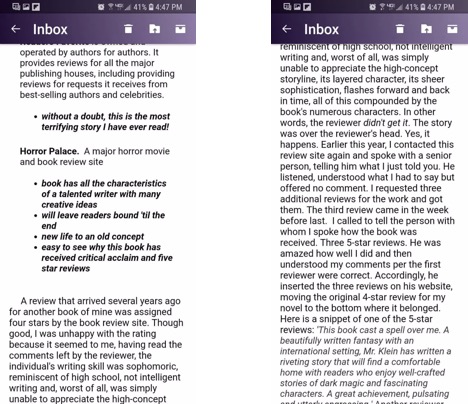


I’ll just wait here for a moment while you all take this in. 

…. kind of amazing, am I right? After reading this, you totally want to buy this man’s book and read it, right?! 
But wait, dear readers! It gets BETTER. 
In the author’s note, Klein writes: 
“And please note this – both novels were read by an entire Barnes & Noble store management team and were deemed so good by the two assistant store managers and the store manager that they were ordered and shelved right next to the works of Mr. King himself.”

Dean Klein, author’s note for Hell’s Shadows
I don’t… I don’t know how to break this to you, dear author, but the mostly likely reason you were shelved right next to “Mr. King himself” is that your last name is KLEIN and most stores do tend to shelve things alphabetically in their respective genres. KL comes after KI so… yeah. Draw what conclusion you will there but I think most of us can figure that one out. 
I’m not done yet. 
There’s also the fact that this fine fellow also tends to be a complete toe-rag to those who have dared to give him a negative review on Amazon.

Now, this is absolutely NOT A REVIEW of Dean Klein’s Hell’s Shadows book, but if it were a review, then it would say this: 
Title: Hell’s Shadows | Author: Dean Klein | Publisher: CreateSpace | Pub. Date: 16 November 2012 | Pages: 426 | ISBN: 1480279102 | Genre: Horror | Language: English | Triggers: None | Rating: 1 out of 5 | Source: I received a copy of this book for review consideration 
Hell’s Shadows Review 
Robin and Gil are married and want to buy a house, unfortunately they don’t like any Estate Agent Elaine shows them until she shows the uninhabited, probably haunted ‘Parsons Knoll’. Parsons Knoll isn’t overly happy to have potential new tenants so tries to kill Elaine. Naturally, Gil and Robin then must buy this house. 
The premise for this book could really have been something, and I think with some heavy editing and maybe cutting out 200 pages of the book, could have had the potential to build tension well. This book promises to be the scariest haunted house book you will ever read, yet unfortunately falls short of this promise due to a heavy reliance on dialogue and repetition the whole way through. For example, Robin would find out some information from Alvina which might be a few pages worth of potentially interesting development, she would then feed it back to Gil in almost as many pages (or so it at least felt). 
The characters were fickle, especially Robin, who literally spent every other page changing her mind as to whether or not she wanted to stay in the house or not. Gil was patronising and a bit sexist and their relationship with the police was quite unbelievable. I didn’t really like any of them and though that isn’t always necessary it would have helped Hell’s Shadows a good bit. Alvina, this old woman (who’s like over 100 years old so knows loads about the house) accent is too much and it cast a shadow on the read and her character for me. 
Unfortunately, for the first third of Hell’s Shadows the writing failed to engage me. The majority of sentences start with ‘But’ which is something that we all fall prey to sometimes, but just doesn’t make for a good read.  It gets a bit better in the middle, but the problem reappears near the end. 
Hell’s Shadows has potential, but again it is severely hampered by problems that could be fixed by the attention of a good editor. As it stands it is a painfully slow read that doesn’t allow the premise to shine like it could have. (Sometimes 100 pages feels like 3, and sometimes 3 feels like a hundred. Bookworm relativity.) 
Unfortunately this was not a pleasant reading experience, but I do hope the author continues to work hard at refining his skill. 
1 star. 
That is the review that would have been posted. Because we do try to be nice on occasion. The following is (posting with Sian’s permission) the original review had we not been so nice: 
Robin and Gil are married and want to buy a house, unfortunately they don’t like any Estate Agent Elaine shows them until she shows the uninhabited, probably haunted ‘Parsons Knoll’. Parsons Knoll isn’t overly happy to have potential new tenants so tries to kill Elaine. Naturally, Gil and Robin then must buy this house. 
The premise for this book could really have been something, and I think with some heavy editing and maybe cutting out 200 pages of the book, could have had the potential to build tension well. This book promises to be the scariest haunted house book you will ever read, yet fails to build any tension and drama due to a heavy reliance on dialogue and repetition the whole way through. For example, Robin would find out some information from Alvina which might be a few pages worth of potentially interesting development, she would then feed it back to Gil in almost as many pages (or so it at least felt). Yawn. 
The characters were fickle, especially Robin, who literally spent every other page changing her mind as to whether or not she wanted to stay in the house or not. Gil was patronising and a bit sexist and their relationship with the police was ridiculously unbelievable. I didn’t really like any of them. Alvina, this old woman (who’s like over 100 years old so knows loads about the house) accent is gimmicky and cheapened the read and her character for me. 
Now, the plot is bad and the characters are bad, but at least the writing is engaging? Unfortunately not, for the first third of the book, the majority of sentences start with But, for absolutely no reason. I thought this had gotten better later on but maybe I just started to notice it less. Then they started appearing again. Have you ever read 100 pages of a book, and felt like you had made incredible progress, and then looked down at the page count and realised you had actually only read 3? That’s what this entire book felt like. I don’t usually DNF reads but this book has taught me that should be the option I choose in future. 
1 star. 
So, I said there were a few things that Dean Klein had done wrong. What was the final thing, you ask? 
The final thing was that he fucked with my crew. You do NOT talk down to me and my team like that and get away with it, you pathetic excuse for an over-privileged and underwhelming rectal sore masquerading as a man. I don’t need a college degree to spot an asshole, nor one to understand how not to be one.
See the original post HERE


The response you are looking for is WTF?!

But yes, people do behave like this. I have had similar experiences. And I know you probably want the specifics of those experiences now that you've seen what can happen, but I will not be sharing them for several reasons:
A) I don't have a clause like the one in the above article,  
B) the only time things between me, my team, and an author are not confidential is if I have to take something to a law enforcement or a lawyer or if I am given permission from an author to share something, 
(Note: Yes, I have had to take someone to court. Yes, it was a pain in my ass. And yes, I would still do it again if I had to or if anyone ever defamed or libelled me. So don't test me. LOL)
C) these are toxic experiences and people I have any interest in holding on to and have broken ties with, 
D) I'm just not an asshole.
I also like to believe most people eventually grow and realize the error of their ways. I won't be working with them ever again, but I also am not going to name names and potentially affect their future opportunities. In some cases, I do believe in calling people out, just as Lilyn did in the above piece, and I respect her for supporting her staff and doing so, especially since the author in that scenario kept escalating things and was attacking even readers in a public forum and was refusing to let up. It was the right way to handle it in that situation. But in my cases, the guilty parties already know who they are and what they did, and are not in my life anymore. And I sincerely hope that I never have to make anything public in order to protect others from the same abuse.

All that said, it's unbelievable to me how highly some people think of themselves and how uncivilized, unprofessional, and just plain horrible people can be to you when you dare disagree with them or point out something that could be improved. I am not saying a writer can't be confident, of course; a writer needs to be confident. But they also need to be realistic, self-aware, and respectful of others.

Sort of like all people in life in general need to be...

For the most part, writers who work with editors do learn this over time, if they don't start off that way. An editor is there to help make a book the very best version of itself, and that often means swallowing one's pride and being open to constructive criticism, even when it results in a little bit of temporary heartache and having to kill some of one's darlings, as we say. As creators of any piece of work, we can't see our own creations objectively, whether we think we can or not. Not right away. We need professionals to help us see through the fog. We might not agree with them even after that fog clears, but more often than not, after a little time, we see what said professional meant and why. Only then can we tweak and revise to find that sweet spot.

That end result is why editors, reviewers, and the like exist at all. We do not exist to just pat you on the back and praise you. We are paid (sometimes haha) to find the weaknesses and make sure you see them, as well as help you learn different ways you could address said weaknesses. If that's not what you want, you shouldn't hire an editor, request reviews, or probably even put a book out there at all because just as someone somewhere will like it, someone somewhere will dislike it. And artists of all kinds have to accept that and be respectful of others' opinions.

However... Sometimes people just don't. Sometimes a writer thinks they are perfect and because Mr. X thought it was brilliant, Ms. Y said it was a revelation, and Dr. Z told you it was engaging, doesn't mean it will be to everyone. Just like not all people have the same sense of humor, nor react the same way to things, nor have the same feelings and even morals. And just because a person--including the writer himself or herself--believes something does not make it so. Besides, a writer wants as many people as possible to enjoy their work, right? For that to happen, it requires listening to and considering the constructive criticism of people whose opinions are different from yours, who have pinpointed examples and explained how a reader could react to something in your manuscript. It's a new set of eyes, a fresh angle on something you are way too intimately attached to and know way too much about to see clearly from another person's perspective.

I'm not saying a writer has to take all the suggestions that are made to him/her. If they did, they'd have a Frankenstein book on their hands because, again, there are a million different opinions out there. But when you reach out to a professional, an expert in a field with experience and training, you should at least be open. You can't shut it down immediately. You can't take it as a personal attack. You can't claim your own opinion is fact. You can't then attack us for trying to help you, for doing the job you asked us to do.

If you think about it, attacking us for critiquing your work and doing our job is actually you doing to us exactly what you feel we've done to you. You are attacking our life's work, belittling us, hurting us, and so much more. Except we haven't done that. And if you feel we have, it certainly isn't intentional while your attack is. Because believe it or not, just as we expect you to be respectful to us, we are respectful of you. We carefully word our comments, we rework our revision letters to soften any hard blows so they are actually more helpful to you, we have others even read our work sometimes to ensure we are coming across the way we intend and are not. Yes, sometimes, things come out wrong even after all those steps. Certain people are more sensitive to specific things than others, too, which we can't always know, and everyone has different triggers. So we try our best.

We aren't going to sugarcoat every single thing for you, though. If we do, it's doing you and your project a disservice, especially if that candy coating makes you think a comment isn't significant when it is really a major issue that needs to be addressed one way or another. We will do our best to share our thoughts, responses, experiences, and expertise in a way that gives it the importance it needs and to get our point across most effectively based on what we do know about any given author, but we are human, too. And we have you and your book's best interest at heart at all times--it's why you hired us. It's what we do.

Remembering all these things and being respectful of your editors, reviewers, and readers is the only way you will ever succeed in this industry.

And what do you know? Doing that in life overall is also the only way you will ever truly be happy (and a good person).


Saturday, September 6, 2014

Classic Novels Had Inspiration Too

One of the questions I always ask authors is what inspired them to write their novels. All stories come from something, whether its the seed of a character, a plot, a theme.

I often wonder this same thing when reading the classics, with unfortunately no way to get that extra insight, that authorial intent. (That said, while I find it intriguing to know authorial intent, it doesn't mean I read the book that way personally, and that's totally okay.) And now, HuffPo Books posted an article yesterday about some of the true stories behind some of the great novels. Maybe not "inspiration" per se, but this more than whets my appetite:

According to Jack London, "You can't wait for inspiration, you have to go after it with a club." London himself took the inspiration for The Call of the Wild (1903) from his time spent living in Canada and Alaska during the Klondike Gold Rush when high-quality sled dogs -- like those that feature in the book -- were in impossibly high demand. The stories and inspirations behind fifteen more of literature's most memorable titles are explained here:  
Anna Karenina (1877), Leo Tolstoy In January 1872, the death of a 35-year-old woman was reported in the Russian press: smartly dressed and carrying a bag containing a change of clothes, the girl had thrown herself under a freight train at Yasenki Station outside Moscow. The woman was identified as Anna Pirogova, a distant relative of Leo Tolstoy's wife and the mistress of his good friend and neighbour, Alexander Bibikov. It soon transpired that Alexander had told Anna that he planned to leave her and marry his son's new governess, and, unable to cope, she had left him a brief note -- "You are my murderer; be happy, if an assassin can be happy" -- and fled. Tolstoy himself attended Anna's post-mortem the following day, and by all accounts the sight of the unrecognisable body of a woman he had known so well stayed with him long afterwards, so that when he came to begin a new novel more than a year later he already had its tragic conclusion in mind. 
The Birds (1952), Daphne Du Maurier Dame Daphne Du Maurier is well known for having taken inspiration for some of her most celebrated works from her adopted home county of Cornwall in the far southwest of England. Jamaica Inn (1936) was inspired by an overnight stay at the real-life Jamaica Inn, an isolated 18th century pub on Bodmin Moor, in 1930. Frenchman's Creek (1941) was inspired by Readymoney Cove, where Du Maurier owned a holiday home on the coast. And the imposing Manderley estate in Rebecca (1938) was at least partly based on Menabilly, a grand country house that Du Maurier herself moved into in 1943. It was while at Menabilly that she saw a flock of seagulls following a plow at a nearby farm and was struck by a simple yet unnerving thought -- what would happen if the birds attacked? The resulting story, The Birds, first appeared in Du Maurier's collection The Apple Tree in 1952. 
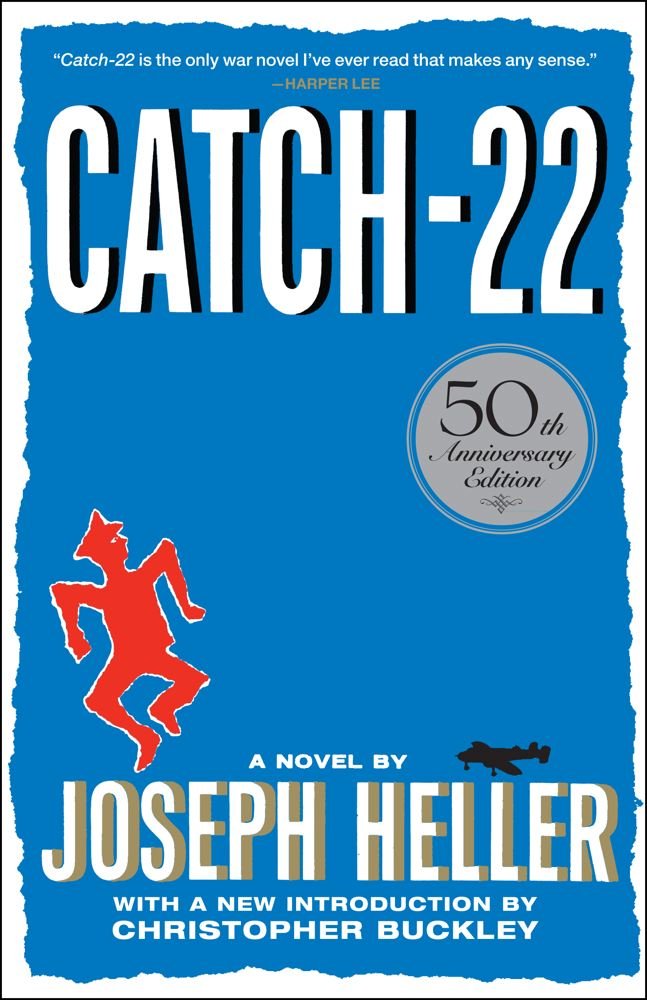
Catch-22 (1961), Joseph Heller Joseph Heller joined the US Army Air Corps in 1942 at
the age of 19, and went on to take part in more than 50 European bombing raids before the end of the Second World War. His military service affected him greatly -- he became an angst-ridden chronic nail-biter, with a habit for screaming in his sleep -- and it took him another eight years to begin dealing with his experiences in writing. After a few dreary post-war years working as a copywriter, one afternoon in 1953 a line simply popped into Heller's head: "It was love at first sight. The first time he saw the chaplain, Someone [he had yet to name Captain Yossarian] fell madly in love with him." Heller wrote the first twenty pages of what he presumed would merely be a short story over the next seven days, but it took him another eight years to complete what would eventually become Catch-22. 
Crime & Punishment (1866), Fyodor Dostoyevsky When he began writing it in the early 1860s, Dostoyevsky originally envisioned Crime & Punishment as a novella entitled "The Drunkard", in which he intended to explore the consequences of alcoholism on family life. That was until he discovered the writings of a French writer and murderer named Pierre François Lacenaire, who had been executed in Paris in 1836 for the brutal killing of a young man and his mother. While in prison, Lacenaire had written essays and poems, met with journalists and researchers, given interviews, speeches and press conferences, volunteered for psychological studies, and even offered to have a life mask made of his face, all on an apparent quest to become an icon of social injustice and guarantee his notoriety endured long after his death. It's unclear whether Dostoyevsky had already created the character of Raskolnikov by the time he heard of Lacenaire, but there are a number of striking similarities between his murder of the pawnbroker Alyona Ivanovna and her half-sister Lizaveta in Crime & Punishment and Lacenaire's own crimes 30 years earlier. 
Frankenstein (1818), Mary Shelley Frankenstein was famously written in response to Lord Byron's suggestion in the summer of 1816 that the guests at his villa on Lake Geneva -- including the poet Percy Bysshe Shelley and his future wife, Mary -- should each write a ghost story to pass the time. After initial reservations, 19-year-old Mary more than rose to the challenge by penning what is now considered masterpiece of gothic horror, inspired by a single terrifying image that popped into her mind as she lay in bed. "When I placed my head on my pillow..." she recalled in the introduction to her novel, "I saw -- with shut eyes, but acute mental vision -- the pale student of unhallowed arts kneeling beside the thing he had put together." The first edition of Frankenstein was published anonymously just two years later, followed by a second edition in 1822, a stage version in 1823, and finally a revised third edition in 1831 dedicated to Mary's then late husband, who had died nine years earlier. 
The Hound of the Baskervilles (1902), Arthur Conan Doyle In July 1900, Arthur Conan Doyle met an English journalist named Bertram Fletcher Robinson on board a ship returning to England from the Boer War. The pair quickly became friends and the following year Doyle agreed to visit Robinson at his home in Devon, southwest England, with an eye to collaborating on a new novel. Robinson took Doyle up onto Dartmoor, a vast ancient moorland (and now a National Park), and regaled him with an old folktale about a notorious local squire named Richard Cabell who had apparently sold his soul to the Devil -- when he died in 1677, local legend claims a monstrous pack of jet black hounds descended from the moors to escort his soul into Hell. Although Doyle had agreed to co-author a book with Robinson, after putting pen to paper the story quickly evolved into a new Sherlock Holmes mystery (his first in eight years) and Robinson's input was relegated, in his own words, to "assistant plot producer." 
Jude The Obscure (1895), Thomas Hardy It is unclear precisely who inspired Thomas Hardy's tale of a young working-class man's struggle to become a scholar, but it seems likely that the eponymous Jude Hawley was at least partly based on Hardy's tragic friend Horace Moule. Born in 1832, Moule earned a place at Oxford University in 1851, but failed to receive his degree. Moving to Cambridge University three years later, it took him another 14 years to finally complete his studies, during which time he battled alcoholism and severe depression until finally, in September 1873, he committed suicide by cutting his own throat as he lay in bed. He was just 41 years old. 
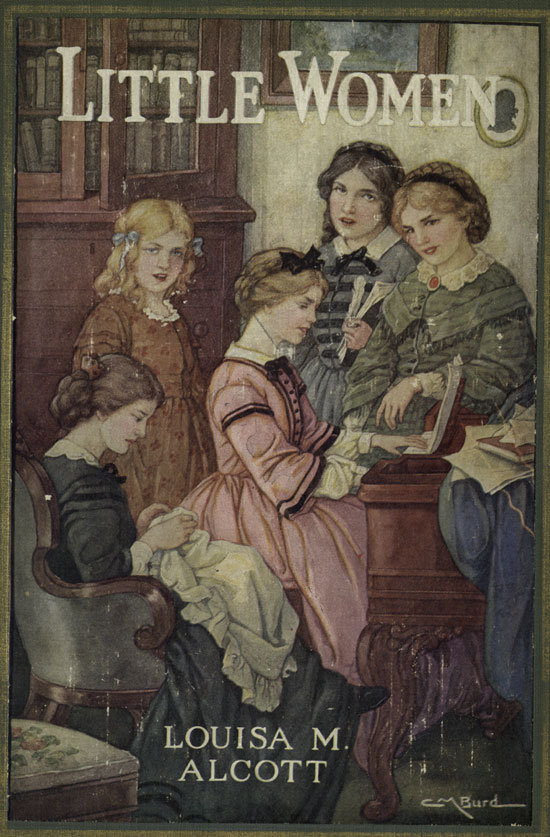
Little Women (1868-9), Louisa May Alcott The four eponymous March Sisters in Louisa May Alcott's Little Women were all based on the author and her three sisters. Louisa herself was the strong-willed protagonist Jo; her elder sister Anna was Meg; her youngest sister May was Amy; and her middle sister Elizabeth, who died at the age of 23, was Beth. The setting and the sisters may have been the alike, but the events and circumstances around them were not: the Marches were by no means rich, but the Alcotts lived in near abject poverty for many years during Louisa's childhood. What's more, the March family's father -- a philanthropic and scholarly Civil War hero -- was strikingly different from that of Alcott's own father, Bronson, a pacifist vegan schoolteacher and an early advocate of transcendentalism. 
Middlemarch (1872), George Eliot In January 1869, George Eliot wrote a list of tasks in her journal that she wanted to complete in the coming year, one of which was "a novel called Middlemarch." Although Eliot seemed determined to set to work, progress on the new novel was slow and when her son Thornie contracted a fatal case of tuberculosis later that year she ceased writing completely; by the time Thornie died in October, Eliot had produced just three chapters of what would eventually be an 86-chapter work, and she promptly shelved the project. By all accounts Eliot did not recommence writing until more than a year later, when, in November 1870, she began an entirely new work entitled Miss Brooke. This new story introduced an eponymous character named Dorothea, but sometime during Miss Brooke's development Eliot saw the opportunity to merge its narrative with that of the three chapters she had shelved the previous year, and Middlemarch was born. 
Moby-Dick (1851), Herman Melville Herman Melville's own experiences on board a Pacific Ocean whaling ship, the Acushnet, in the early 1840s provided the primary inspiration for his novel Moby-Dick, and later editors and commentators have since even been able to draw parallels between Melville's real-life fellow crewmembers and the characters in his book. The Acushnet was far from his only inspiration, however, as Melville was doubtless also influenced by the true story of a whaling ship named the Essex that was attacked and sunk by a sperm whale in the central Pacific in 1820. Melville later met the son of one of the Essex's eight surviving crewmembers during his time on the Acushnet, and after the publication of Moby-Dick in 1851 met with the ship's captain, George Pollard, whom he later described as "one of the most extraordinary men I have ever met." 
Robinson Crusoe (1719), Daniel Defoe It is widely believed that Daniel Defoe's Robinson Crusoe was based on the true story of real-life castaway Alexander Selkirk, but that's by no means guaranteed. In fact, there are such telling inconsistencies between the two tales -- Selkirk was voluntarily marooned in the Pacific, while Crusoe was shipwrecked in the Caribbean; he was stranded for just four years, compared to Crusoe's 28; and Selkirk was alone, while Crusoe's tale involves encounters with natives, cannibals and pirates -- that some editors have suggested Defoe likely had another story in mind. It may be that Crusoe's tale was based on the 17th century sea captain Robert Knox's 19-year imprisonment on Ceylon, which was published as An Historical Relation of the Island Ceylon (1681), or else on the British doctor Henry Pitman, who escaped from a British penal colony in the Caribbean before being shipwrecked on a nearby island. Alternatively, there could be some truth in Defoe's own claim that Robinson Crusoe was the true story of a man he knew personally, and for whom he simply served as memoirist. Whatever its true inspiration, there's no doubting the success or impact of Defoe's novel, which ran to four editions in its first year alone and has remained enduringly popular ever since. 
The Strange Case of Dr Jekyll and Mr Hyde (1886), Robert Louis Stevenson Robert Louis Stevenson had already written a play about Deacon Brodie -- an 18th century Edinburgh city councillor who led a double life as a burglar -- when in 1885 he had a dream about a mild-mannered man transforming into a monster. His wife Fanny later recalled how, "In the small hours of one morning... I was awakened by cries of horror from Louis. Thinking he had had a nightmare, I awakened him. He said angrily, 'Why did you wake me? I was dreaming a fine bogey-tale.'" She had woken him, she later discovered, at what would eventually become Jekyll's first transformation into Mr Hyde. 
The Thirty-Nine Steps (1915), John Buchan John Buchan was recovering from a stomach ulcer at a nursing home in Broadstairs on the far southeast coast of England he began work on what he referred to as his first "shocker" in 1914. Buchan reportedly took the title of the novel from a wooden staircase that once ran from the clifftops at Broadstairs down to the beach, although there are several conflicting accounts: one version of the story has Buchan's young daughter running down the stairs two at a time and announcing that there were "39 steps" down to the beach, while another claims that as there were actually 78 steps Buchan either halved the number simply to make a snappier title, or else changed it because he was 39 years old at the time. 
Three Men In A Boat (1889), Jerome K. Jerome In the mid 1880s, Jerome K Jerome came up with the idea of writing a straightforward travel guide to the River Thames, including descriptions of several historical sites along its course. As he began to compile it, however, Jerome's guide became increasingly filled with humorous anecdotes and bantering conversations recalled from boat trips he had taken along the river from London to Oxford with two of his friends, George Wingrave and Carl Henschel. Together, the three men became the eponymous Three Men In A Boat, with the addition of Montmorency the dog having, "as Jerome admits, developed out of that area of inner consciousness which, in all Englishmen, contains an element of the dog", according to Oxford World's Classics. 
To Kill A Mockingbird (1960), Harper Lee Harper Lee has long denied claims that To Kill A Mockingbird is an autobiographical work, but rather a reflection of an author simply writing about what he or she knows and has experienced first hand. Either way, it's hard not to see parallels between her Pulitzer Prize-winning classic and her childhood growing up in Monroeville, Alabama. Just like Scout, Lee's father practiced as a lawyer, and in 1919 was faced with defending two black men accused of the murder of a local white shopkeeper (both men - a father and son - were later hanged). Moreover, Lee, like Scout, was a tomboy in her youth, and her eldest brother Edwin, like Jem, was four years her senior. She wrote the book in the years following the death of her mother in 1951, and in the story Scout too has lost her mother. And even the character of Dill, who lives next door to the Finch family during the summer, is modelled on her childhood friend Truman Capote, who would spend the summer with his aunt in Alabama while his mother visited New York. 
See the original post HERE

Monday, August 18, 2014

Books to Film: An Emotional Process for Some Readers

Film adaptations can be difficult for some people. I have a friend who really struggles with watching a movie of a book she likes because she gets so frustrated with the changes made by the filmmakers. I used to be that way, too, actually. I remember very clearly going to see Harry Potter and the Prisoner of Azkaban and being so distraught over how the new director reimagined the world and changed things about the dementors and left out this and that and on and on I went. My poor boyfriend at the time. I was nearly in tears. 

Excessive, yes, I know. But it was that experience that forced me to change my mindset. I've always been intrigued by adaptations (despite the occasional what-did-you-do-to-this-book-I-love?! meltdown), and in time, I learned to separate the book from the movie, to focus on the heart of the story and how two different people can take that same essence and bring it to life in two totally different ways. It's those changes that now interest me the most, even when a book I loved was maybe not done in the way I would've done it.

I always wonder what it must be like for the author of a book, if the changes in a film adaptation are s so hard for some readers to accept. I'm sure it varies like anything else, but it was great to get some insight from two-time Newbery Medal winner Lois Lowry this morning on HuffPo as she writes about her experience with The Giver adaptation, which just opened in theaters across the country:

I've been watching The Giver movie project for many years and read a lot of scripts. After I'd gone to the set and sat in the editing room, it began to feel like a jigsaw puzzle. You have the blue pieces here, and the yellow pieces over there, and then it begins to all fit together. When I finally saw the final movie with the music in there, it was kind of overwhelming. It was a very gratifying experience to see that it was done with such regard for the book. It retains the essential ingredients of the book, while adding all of the visual stuff that a movie needs but that a book sadly cannot have. 
I think the film does what a film should. It takes a book -- the heart of the book and the integrity of the book -- and it adds to it what only a film can add: the visual stuff, the suspense, and the back and forth that the book doesn't do.  
I chose the images in the book carefully, but I think I didn't choose enough of them. The movie makers have taken my work and retained the questions I wanted to raise, but they expanded it and brought it to a new level -- a wonderfully visual level, at that. When I wrote the section of the book about the boy out on his journey with the baby, I felt restrained. As a writer, I had only one character really out there. I had a baby who didn't talk, so there could be no dialogue. There was description of landscape, but how many pages can you do that? And yet in the movie, you still have the boy, and the baby who doesn't talk, and therefore there's no dialogue, but you have that incredible landscape -- partly in South Africa -- and it almost becomes a character in the film. I was very moved by that. 
One of the things that particularly struck me were the wonderful memories that the boy is given. It seemed to me that they had incorporated every bit of the past world into such fleeting images, and each one was carefully chosen. Now having seen the movie, I'd love to go back, rewrite the book and incorporate some of those things that are in the movie. One of the things I wish I could beef up now are those memories -- the different religions, for example -- little flickers of a baptism, of an immersion, of a mosque. There is a section where the boy is going to flee and he goes to The Giver, who gives him some final memories so he'll have strength. It's that selection of memories that I found most gripping. In particular, the image of the boy in front of the tank in Tiananmen Square; that's not in the book, but wow is it powerful in the film.  
From the beginning, I felt as though the book was in good hands. The reason for my feeling that way was because both Nikki Silver, the producer, and Jeff Bridges, the producer and star, were so passionate about the book and dedicated to retaining its integrity. Although the chances of the film getting made fluctuated over the years, I never worried about how it would be made because I knew about their passion, and respected and trusted that. 
And the other night, there I sat in the theater. I knew the story. I had read the screenplay. I knew how it was going to end. So nothing was a surprise, except that everything was a surprise because of how overwhelming it was, how many shivers went up my spine and how terrific it felt to watch it. The movie is finally out there and is a vast, beautiful, finished piece. 
See the original post HERE

Tuesday, June 10, 2014

Stephen Colbert Fights Back Against Amazon

By now, we've all certainly heard about the whole Amazon-Hachette ordeal. We all have our opinions and frustrations, but for the most part, expressing our views on the matter goes unnoticed as such small fish in such a big pond. 

There are some people, however, who can get the word out to thousands and thousands in one fell swoop, just as popular television personality Stephen Colbert did earlier this week. 

I'm not usually a big Colbert fan, but I've gotta say, the below makes me smile so big. 

The Huffington Post tells us more:
Nobody, but nobody messes with Stephen Colbert's book sales, not even Jeff Bezos.
In the midst of Amazon's ongoing fight with Hachette, the "Report" host took a little time on Wednesday to express some choice words -- and gestures -- for the online retailer. 
Check out the clip [below] to see Colbert let Amazon know how he feels about a 3-4 week shipping delay on his books, and [even further below], see his interview with author Sherman Alexie about how the Amazon/Hachette fight affects authors. More importantly, watch Colbert unveil his plan for how to beat Amazon at their own game by offering book pre-orders on his own site. 
See the original post HERE 


Tuesday, April 2, 2013

Authors Give a Hand to Young Writers

Writing is not an easy job. I should know--I've been sitting on partially written manuscripts since I was about 12. Editing I can hop to, no problem, but writing? Writing is tougher for me. Putting my own ideas down on paper is a terrifying thought.

I'm not alone in this fear though, and oftentimes writers need a little encouragement from their peers to get over the hump. Yesterday, BuzzFeed gave us a hand, by sharing "27 Pieces Of Advice For Writers From Famous Authors: where "Celebrated authors, editors and illustrators write advice to young writers on their hands for “Shared Worlds,” a two-week creative writing summer camp at Wofford College."

Here are some of my personal favorites:


1. Neil Gaiman.

Neil Gaiman.
Award-winning author of American Gods, Coraline, Stardust and many more.

3. Garth Nix.

Garth Nix.
Award-winning author of the "Old Kingdom," "Seventh Tower" and "Keys to the Kingdom" series.

4. Karen Lord.

Karen Lord.
Author of Redemption in Indigo and The Best of All Possible Worlds.

5. Patrick Rothfuss.

Patrick Rothfuss.
Author of The Name of the Wind and The Wise Man's Fear.

8. Jody Lynn Nye.

Jody Lynn Nye.
Award-winning author of more than forty novels and one hundred short stories.

9. C.S.E. Cooney.

C.S.E. Cooney.
Noted author of science fiction short stories and poetry.

15. Lev Grossman.

Lev Grossman.
Bestselling author of The Magicians and The Magician King.

16. Gregory Norman Bossert.

Gregory Norman Bossert.
Noted short story author and illustrator.

17. Scott Eagle.

Scott Eagle.
Noted author and illustrator.


18. Jeff VanderMeer.

Jeff VanderMeer.
Award-winning editor, publisher and author of City of Saints and Madmen, among others.

26. Karin Tidbeck.

Karin Tidbeck.
Award-winning Swedish author of fantasy and weird fiction.

See them all HERE